Palm Springs: martinis, lounge chairs by the pool, chic boutiques, that Frank guy on the stereo, all against the backdrop of desert and mountains. It was just what I expected, and also not. To be sure, it has that quality of fabulousness everywhere, as in “darling, that is drop-dead fabulous.” But Palm Springs is more multi-layered than that. The first impression I had was that it just appeared out of nowhere. We were driving on an almost-deserted highway, looking at endless dry and dusty vistas of treeless, building-less, everything-less expanse, and I was truly worried that we had taken a wrong turn, because GPS said we were only a couple of miles from Palm Springs, so where was it? And then, suddenly, like an oasis in a B-movie, we were on a town street lined with greenery and civilization. It literally arose out of the desert.
The deep Native history of Palm Springs is still evident in the checkerboard layout of the town, where every other 1-mile-square is owned by the Agua Caliente band of the Cahuilla tribe. Although there was some early European settlement in the area, it wasn’t until the 20th century that Palm Springs became a health resort, a hideaway for celebrity rendezvous, and a locus of mid-century design fabulousness.
We took a walking tour (natch) given by the Historical Society, and as we traversed the streets, a key fact about Palm Springs became clear. It is an insider town. Unless you are visiting someone who lives or snowbirds there, you just can’t see much. High hedges and gates surround most houses, because…celebrities. But I know what is back there, at least in concept, even if I can’t see particular houses. It’s lifestyle, a very American invention from the middle of the 20th century.
It’s worth noting that before the Postwar years, no one thought about the style of their lives, as in “casual lifestyle” or “formal lifestyle.” Before that, it was usually economic class and/or location that determined how one lived, not a choice about things like whether to permit kids in the living room or how often to change the bed linens. But something entirely new emerged in the “American Century” (that was in reality a half-century) after World War II, a purely American idea. The War was a watershed for how Americans lived: before, in closed-off rooms with as much elegance as possible; after, in open floor plans with simple furniture and feet on the coffee table. (Coffee tables themselves were new, likewise coffee table books, ashtrays, and the pile of magazines.)
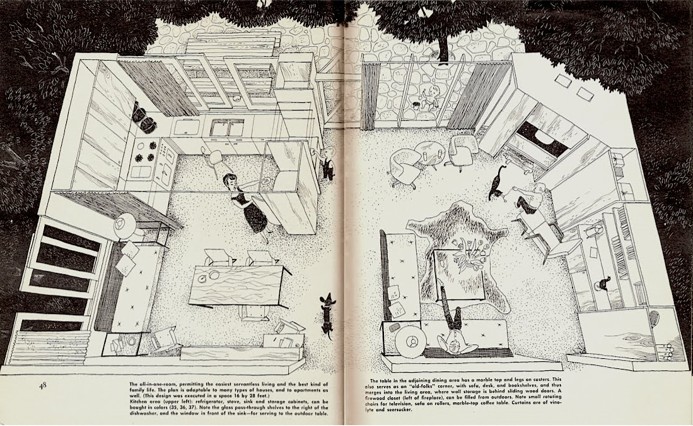
In Palm Springs and most of the new American suburbs, houses were thought of completely differently after the War. Floor plans now had kitchens that were aesthetically important because they were open to dining and living areas, so built-in cabinetry and matching-color appliances appeared. Bedrooms were smaller, and there were more bathrooms, and oh-so-many closets to hold all the possessions of that prosperous era. Garages were integral, because cars had become integral. Living areas with large windows flowed onto another new thing: the patio. Open, flowing, unrestrained, easy were the watchwords of the era’s houses and new ways of living.
New publications and experts emerged around the issue of lifestyle. Among my favorites is Mary and Russel Wright and their Guide to Easier Living (1950). I was part of the staff at Manitoga, the remarkable home the Wrights built in an abandoned quarry on the Hudson River, and I wrote my master’s thesis on their 1940 project called American-Way, so maybe I am a bit biased. But the Wrights, like their more famous non-relative Frank Lloyd Wright, were focused on how Americans should live in the modern era, and their work greatly influenced the newly-developing American lifestyle. Their signature industrial design, American Modern dinnerware (still the largest-selling of all time), told the whole story. American: informal, inexpensive, widely available; and Modern: simple lines and plain-color glazes, with no applied ornament, just pure form.
In their Guide to Easier Living, the images showed open living spaces with numerous windows and built-ins as most of the furniture, washable surfaces and throw rugs. The text decries the “Old Dream” of what the Wrights called “fussy” living that demands too much effort, too much cleaning, and most of all, too much outmoded stuff. Simplify everything, they advise: instead of dining room furniture and formal china only used twice a year, have a farmhouse-type kitchen with the table right there, and one set of inexpensive earthenware dishes. If it all sounds like a precursor to how millennials today live, it is. Homes are for relaxing, so let the children be welcome everywhere, and make your entertaining potluck style instead of multi-course dinner parties. It is hard to convey how utterly ground-breaking all of this seemed at the time, but also how perfectly American.
A revolution in ways of living didn’t end up meaning that mid-century Modern design caught on in a big way. In California, MCM was such a good fit for the climate and hip, relaxed lifestyle. In, say, northern Maine, it’s not quite as salubrious to have large panes of glass and sliding doors to a ground-level patio. So some of the best MCM is not surprisingly in California, where you can have breakfast as we did every day in Los Angeles, on the patio by the pool. In Pacific Palisades, the hills above Los Angeles, is an enclave of houses that are as hard to glimpse, let alone tour, as the ones in Palm Springs. Many of them were built as part of the Case Study House program, an attempt to create prototypes for mass-market Postwar American living. The mass-market part was doomed by the location, location, location that drove prices through the roof, just as the modest Palm Springs MCM houses are all now valued at eye-watering prices. There are small groups of surviving MCM houses all over America, including in places as disparate as Raleigh, NC, Lexington, MA, and Alexandria, VA, but in general they have become elite enclaves, not democratic solutions for everyman as they were envisioned to be.
In the end, American mid-century Modern lifestyle has stuck, while MCM design has become just a style beloved by some hipsters and aging Boomers. Americans, it seems, really prefer tradition in our housing choices, whether it suits the way we actually live, or not. The one thing from those MCM houses that is still with us, and even has evolved into a non-negotiable part of the interior of today’s houses, is the ever-present “open plan.” I hear, however, that the open plan where the kitchen sink is adjacent to the sectional sofa is starting to be re-thought. I wonder if the open plan has become enough of a tradition, though, that Americans won’t give it up any more willingly than they did their multi-pane windows, formal dining rooms, and Georgian mantels in the Postwar era.
Yes, I am very fond of bungalows, but I LOVE a good mid-century Modern. We have managed to visit a few of them, such as the Eames and Stahl Houses in Pacific Palisades, and some in the Six Moon Hill neighborhood in Lexington, MA. We even came thiiiiiis close to buying a very modest house in a Philadelphia suburb by the renowned MCM designer Richard Neutra–that will always be the one that got away. When I am in a house where the inside is connected to the natural world outside, where organic materials like wood and stone mingle happily with glass and steel, where spaces are designed with modern life and human needs in mind, I am both soothed and inspired.
If Joey’s and my whole 2026 project is about discovering, re-discovering, and thinking about what America is, it was always going to be a complicated business, because America contains multitudes. There is never a simple answer to any question about what makes up American character, values, or identity. But I do think Americans got close to expressing something about our informal ways of living, our ability to innovate, and our democratic ideals, when we tried living modern life in modern homes in places like Palm Springs in the middle of the 20th century.
Leave a Reply