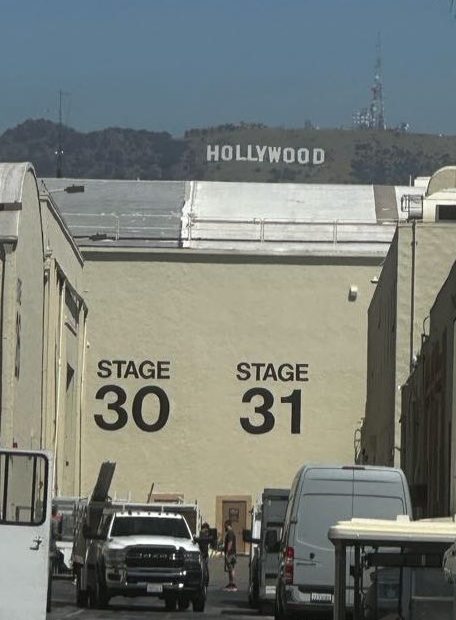
Los Angeles to the visitor doesn’t just encompass Hollywood, it IS Hollywood. Those omnipresent 45-foot-high white letters on the mountainside above LA indicate a neighborhood that is also a business, a technological marvel, a mindset, and maybe the most significant American product ever. When we think Hollywood, we think about the movies of course, but also television and other forms of mass entertainment, all of which are so embedded in our lives that we have no idea what America (and the world) would be like without them.
When Joey and I have visited Los Angeles, both this week and in past trips, we have relished the variety of experiences the area has to offer, from biking on the beach to magnificent museums (e.g. the Getty Center and Huntington) to great food eaten on open-air patios. We have partaken of a whole architectural buffet, from the gorgeous craftsmanship of the Gamble House in Pasadena to the Mid-Century Modern delights in Pacific Palisades to the stunning steel-clad volumes of the Walt Disney Concert Hall in downtown. We have walked miles, including just a few days ago a 4-mile “walk” in the hills behind the Griffith Observatory that turned into a humbling lesson in preparedness (wrong shoes! not enough water! no sunscreen!). Everywhere you go in LA there are epic views, interesting neighborhoods, and relentless traffic (as Dionne Warwick sang, LA really IS a “great big freeway”).
But on this trip what really struck us was the ubiquitousness of the entertainment industry in Los Angeles and what it says about American culture. We toured Paramount Studios with a guide who was a California version of our grandson Kaiden, charming and waggish, and we went to the Academy of Motion Pictures Museum, drove through Beverly Hills, and spent a lot of time talking about the role of mass entertainment on our lives. We are of the television-centric Postwar generation, and of course we have watched movies in theaters and on our couches as long as we can remember. So I know I have been affected by what Hollywood has put into my life, although I am still pondering what the effects have been.
There is a lot of mention in Tinseltown of “magic” in connection with the movies, and what could be more magical than making an alternate reality that we can all enter into? It’s interesting to think about the early days of the movies, when a group of creative and technically daring people moved from New Jersey to the sunny valley that was first called “Hollywoodland,” in order to more easily make their “moving pictures.” They proceeded to make this entirely new thing in sheds and barns and in the middle of the fruit groves. Out of that frenzy of creativity and derring-do within a couple of decades came the whole universe that mass entertainment has become. And I would suggest that those early joyful experimental years infused the movies with the magic they still have, at least to an extent.
At Paramount Studio, we heard about how Alfred Hitchcock took a sound stage that had a basement and turned it into the full New York City building backs that make Rear Window so believable. They flooded a parking lot to make both the parting of the Red Sea scenes in The Ten Commandments and the scene at the end of The Truman Show where he tries to sail out of his fake perfect life. At the Academy of Motion Pictures the production design for Barbie: magic with a sly wink. Magic is everywhere when you make entire worlds from scratch.
We no longer thrill as they did in the 1920s to the sheer novelty of sitting in a dark room with a bunch of strangers and watching, and eventually both watching AND hearing, worlds outside of our direct experience move across the screen. But we do still seem to really love that magic. In the early 20th century, cultural critics worried that the effect of everyone consuming the same diet of culture at the same time would make Americans into conformists. Which it certainly did, at least in the middle of the century. But I am not too sure of the effect of mass entertainment on me, my generation, or this century. The sheer volume of choices now means that we aren’t all watching the same thing, and the ability to generate our own content has made us all into potential creatives, not just consumers. We are too close to our own era and can’t really judge whether Hollywood and its successors have enlightened us or ruined our lives.
After a few days in Los Angeles, Joey and I went from the dazzle and noise to the desert, first Palm Springs and then Joshua Tree. Right now I am writing this as we drive across the seemingly endless, lonely, and achingly beautiful desert toward Death Valley (more about these places later). The clarity of the air, the quiet, the sparse simplicity of the landscape, and the complete lack of cell service could not be any more different from my normal media-filled life.
I can truthfully say hooray for the magic of Hollywood, but I also say that some time without all that is just as magical.
End Note: As I have thought about what movies and television have impacted my life or I have felt have been significant expressions of American culture, I find my list is embarrassingly short. So I would love it if any of you dear readers would give your list of movies or TV that you have found impactful, important, and/or worthy of multiple viewings (which is a sure sign of excellence in my book). I promise to find and view your suggestions, no matter how arcane!


Leave a Reply