Our very first home purchase in 1982 was a little grey bungalow in the Bellevue neighborhood of Richmond. We paid something like $42,000 for it and immediately proceeded to fix it up. Some of the work was necessary, like scouring grimy windows, but most just arose from the buoyant energy of thrilled young homeowners, like the two months spent scraping up the linoleum kitchen floor. We loved the house and the time of life it encompassed, including bringing home our daughter Lauren to it in 1986. I think it actually imprinted on us in a mysterious way, because we have been attracted to bungalows ever since.
We have owned a bunch of houses since that first one, and the most recent purchase seems to be a bit of a full-circle moment: in August, 2025, we bought a 1910 yellow bungalow in the small town of Gordonsville, near Charlottesville. We were looking to downsize, and we were hoping for some charm and character, and we certainly accomplished all that. We also seem to have gotten drafty windows, no insulation, and some very questionable renovation choices by the previous owners, so we are embarked on yet another housing adventure at a time of life when that may not be everyone’s choice. Why did we sell our comfortable, safe, large, very nice condo and buy this quirky little house? Rationality may not explain it, but maybe it’s just that bungalows are in our blood.
And it turns out that bungalows in general and this house in particular tell some very American stories. In fact, our new house contains a whole continent of stories, from how bungalows developed in the early 20th century as an expression of middle class morality to how Sears Roebuck became a capitalist juggernaut in the same period, partly due to their innovative idea of selling whole houses that could arrive by railroad car.
The word “bungalow” derives from bangla, denoting a small Indian house, but bungalows became a particularly American form, popular from coast to coast and still ubiquitous today. They developed as an American expression of the Arts and Crafts Movement, which began in England with the likes of William Morris, whose ideas about design are dear to my heart, because he and his compatriots fervently believed that good design changes the world. At a time of rampant industrialization and rampant Victorian eclecticism, the Arts and Crafts idealists worked toward creating simple, honest, well-crafted buildings and objects, made by workers who knew their value and loved their craft. It was, of course, too radically anti-capitalist (Morris was, in fact, a prominent Socialist) and idealistic to actually counter the onslaught of industrially-produced goods, but the movement had an enormous impact nonetheless.
One impact was the beginning of a re-examination of how to be a consumer in the modern world, what made for a good quality of life, and how we are influenced by what we surround ourselves with. Morris famously said to “have nothing you do not know to be useful and believe to be beautiful,” which is perhaps the best decorating advice ever, and which could change the world even today as we fill our virtual Amazon and actual Costco carts. Americans latched on to the Arts and Crafts ideal at the exact moment that the post-Civil War economy was booming, immigration was ballooning, and the country had taken over a good chunk of the North American Continent, sea to shining sea, all of which meant a building boom for middle-class housing. Gustav Stickley, who owned a New York furniture-manufacturing company, went to visit Morris in England and came back ready to give Americans the same honest, well-crafted, beautiful spaces and goods that were available in England. His 1911 Craftsman Farms log bungalow in New Jersey and his “Morris Chair” and oak library tables hit the zeitgeist at just the right moment.
Middle-income Americans looking for homey but simple houses that weren’t knockoffs of European high styles latched onto the Arts and Crafts bungalow. Bungalows have low, spreading roofs and feature lots of unpainted wood, organic colors, and nary a reference to past aristocratic styles. Instead of classical columns, bungalows have chunky porch posts; instead of fancy mantelpieces, bungalows have handmade tile surrounds and pegged wood mantels; instead of veneers, bungalows have plain American oak floors. The furnishings were similarly straightforward and well-made. This wasn’t only a style, it was an expression of a perceived American-ness: sturdy, honest, rugged, and not beholden to outmoded Old World conventions. Plus, it was charming as all get-out.
From Pasadena to suburban Chicago to burgeoning East Coast exurbs, bungalows sprang up everywhere. And then one of the biggest manufacturers and retailers in America, Sears Roebuck, got involved, and the whole concept went from handcrafted idealism to industrially-produced houses sold as complete kits and packed into railway cars for delivery. Sears delivered over 75,000 packaged houses between 1908 and 1940, and although they weren’t all bungalows, many of them were some variant on that form. What began as a few dozen designs (including a two-story school with library and auditorium spaces) sent as cut lumber, hardware, nails, paint, and instructions to cut and assemble the building, morphed into fully pre-cut kits in over 300 designs. The confluence of sophisticated mass-production, massive amounts of timber, railroads connecting almost every American town, and cheap color printing for catalog dissemination, created an opportunity to create charming, affordable, customizable houses built of old-growth lumber on an enormous scale. The like had not been seen before–nor has since.
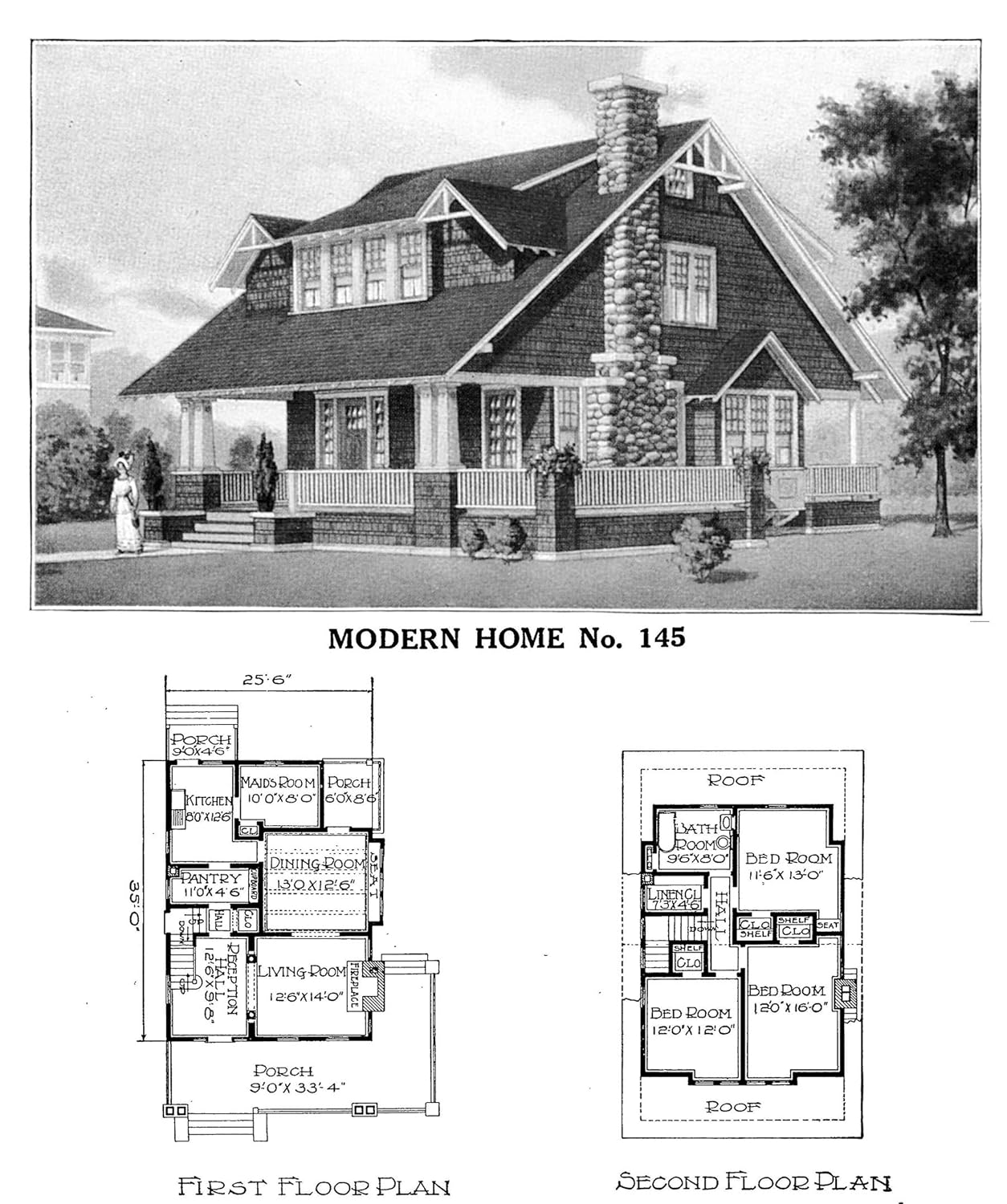
When we bought our house in Gordonsville, we were told that it dates from 1910. Subsequent digging has shown that the “Arlington, Model 145,” wasn’t actually produced until 1911, so now I have a legitimate reason to go down a rabbit hole of fun research. The records of the Sears kit house business tragically burned, so there’s a lot of information that has to be pieced together. Also Sears wasn’t the only, or even the first, company to produce kit houses by mail, so in some cases when there’s a suspicion that an early 20th century house is a “Sears house,” it turns out to be by another company. Or sometimes a locally-stick-built house that copied a kit house that had been delivered to town. We just found an almost identical-looking house around the corner from us in Gordonsville: is it Sears, or is it not? Yay–more research to do!
Kit houses by mail disappeared as decisively as they had appeared, due to material shortages in World War II, changing housing styles, and financial losses sustained by Sears’ mortgage program in the ever-deepening Great Depression. The idea of well-built kit houses for the middle class today seems to be unattainable: a few years ago, we tried to build a house near Charlottesville and looked deeply into kit/modular/prefab options, but it seems that although these exist, they are now the province of the wealthy or are so cheaply made that banks often won’t provide mortgages for them. We have actually built two modular houses in our time together, but both were essentially partially finished boxes sent on trucks and then largely completed on-site, a far cry from the “everything and the kitchen sink” approach of the Sears houses, which were marketed as buildable by one man in less than 90 days.
What would William Morris say about the Sears houses? He would applaud the general simplicity and quality construction, and appreciate the carefully planned interiors with little wasted space and honestly expressed materials. He would, however, be very disappointed that it was industrial capitalism that brought them about. Morris never achieved his dream of good design made for everyone by happy workers; it turns out that quality hand-craftsmanship is expensive and only available to those who can pay a premium for it. One of the most notable aspects of the Sears and other kit houses of the early twentieth century is that they opened up home ownership to a much wider range of Americans, including immigrants and people of color who had largely been excluded from that aspect of the American Dream. The ardent socialist in Morris would be proud of that at least.
Our Sears house has a new bathroom (but the original medicine cabinet complete with murky mirror is still there), wiring, and heat pump, but little else has changed. The leaky windows and doors are sturdy and well-made, so we have to find ways to insulate without replacing them. The maid’s room (yes, there was an actual 8’ x 10’ room by the kitchen designated for a live-in servant in a 1700-square-foot house!) is now an amorphous space at the back of the house, and the former walk-in linen room upstairs now contains the laundry machines, but the window seats, corner beads, butterfly-shaped hinge brackets, and Southern yellow pine newel post all survive. Did we trade comfort and storage space for charm and history? You betcha.


Leave a Reply