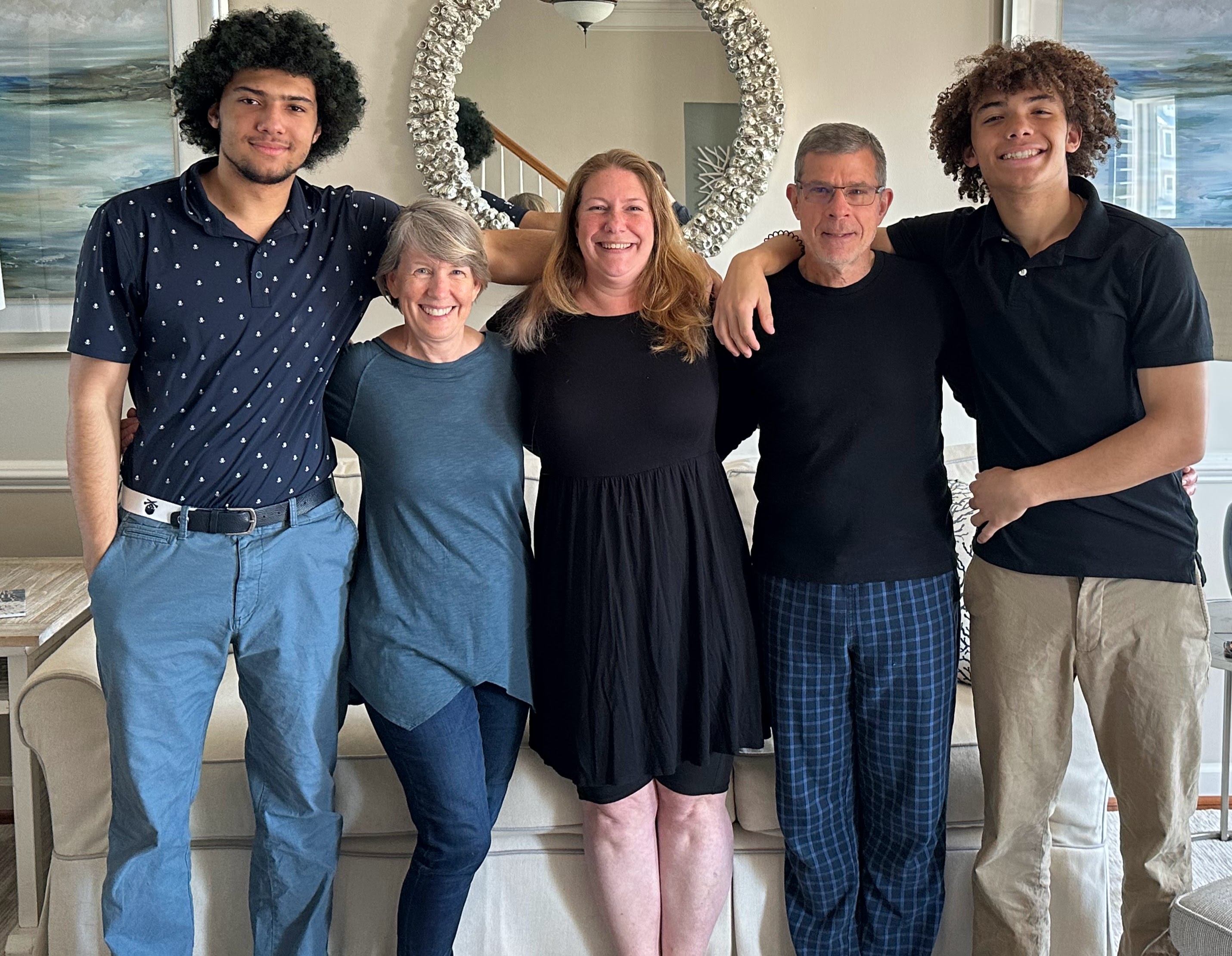
Race is a painful and treacherous subject to write about, but I think it has to be addressed, or we are not facing a central part of who we are as a country. And in our case, part of who we are as a family. Later this year, we will likely write more about the larger story of race in America, after we have visited a few more places. But for now, I am thinking about how, against the odds, living in Greenwich, Connecticut and environs for 14 years brought new dimensions to our own story.
The first and most important thing to say about the issue of race is that for much of our lives, although it wasn’t intentional, Joey and I have had shockingly little interaction with or connection to people of color, not even to mention other religions, ethnicities, or cultures. America may be a melting pot, but our personal experience has been that it is more like a stew that doesn’t get stirred very often, with our particular potatoes mostly lurking together at the bottom of the pot.
Writing about race in America and in our family for me can’t be anything other than confessional. I am no expert, have virtually no understanding of the historic complexities or current realities, and probably personify white fragility (I have read some books). So maybe the best way forward is some snippets of experience.
In my high school class of 400-ish students, only one was Black. Swedes, Norwegians, Germans, Irish, and other Northern European ethnicities populated my Northern Illinois town. In Joey’s Tidewater Virginia hometown, the racial numbers were much more evenly distributed, but, so I gather, the people themselves were not. After the mandated integration of Suffolk schools, athletic teams at the high school were very integrated (Joey was the only white guy to make the basketball team in his Junior year), even if the town’s neighborhoods weren’t. College and grad school for both of us were largely all-white experiences, and I regret to say that I didn’t even think much about it. Same with most of the neighborhoods we have lived in, schools our kids attended, and places we have worked. We didn’t plan it that way, but we also didn’t take note that that was the case.
In the summer of 2000, we left Martha’s Vineyard, where we had lived a woodsy hippie’s life for 6 years and where we thought we would stay forever, and moved to Greenwich, CT. We knew of Greenwich vaguely, and we went there for a great job opportunity for Joey and for school opportunities for our daughter Lauren. In the ironic way life works sometimes, Greenwich High School turned out to be not as good a fit for Lauren as it was for her younger brother David, who thrived in Greenwich. Greenwich, as you may know, is one of the richest towns in America, and although we didn’t fit the economic demographics, we had a lovely life there in a lovely setting with some lovely friends.
We lived in Old Greenwich, a tree-shaded town on Long Island Sound. The first autumn after we moved in, the kids were happily settled in school and I hadn’t yet started a job, so my time was my own. I rode my bike past beautiful old houses and gardens, along the shore road where every lawn sloped gently to a dock with at least one sailboat at anchor. At the end of the road was Tod’s Point, the impossibly gorgeous park with a sandy beach, hilltop views that included the Manhattan skyline in the distance, and wooded glades dotted with benches and the remnants of–what else–a huge stone mansion. It was picture-perfect, just like the other areas of Greenwich, including so-called “back country” where winding roads gave glimpses of huge estates with all the tennis courts, swimming pools, refurbished old barns, and manicured gardens you would expect. As long as you didn’t think about the market value of any of these places, you would feel you had landed in a bit of classic New England. But, of course, the market value is the whole story, because although you can ride by all that loveliness, you can’t live in it unless you are part of the less-than-one-percent. (Our own story of housing in Greenwich is one of miracles, extreme generosity, and fairy-tale-like results, too much to go into here.)
Because truth is occasionally more absurd than fiction, on Father’s Day 2005, while we were sailing with friends on their yacht in Long Island Sound, Lauren blurted out that she was pregnant at age 19. To say that this was a departure from the “Greenwich lifestyle” is an epic understatement. To further note that the father of our grandson Christopher (and a year later his brother Kaiden) was Black, in a city that is precisely 3.3% African-American, may also indicate some of how Lauren’s life choices were, shall we say, out of the norm.
I cannot say that we have ever had or have now, a good relationship with the father of our grandsons. I have to urge you to believe, though, that our issues with him have to do with different world views and choices we do not agree with, and not with the color of his skin. His race, and that of our grandsons, is of no real importance, except as it affects their lives, which of course it does.
The boys grew up mostly in the Raleigh, NC, area, but they spent large parts of most summers with us in New England. Although we loved seeing them have a lot of outdoor and seemingly carefree time with us, it hadn’t occurred to us that they might feel a bit out of place in that environment. Little indicators brought us into their reality, like one time after we had gone to a classical music concert by Yale students in our nearby town, when 10-year-old Christopher said that it had been really nice, but noted “it’s really white around here, isn’t it?” They were always aware of race, while we had the luxury of ignoring it.
Once, sitting around at Christmas, we got to talking with the boys, teenagers by then, about whether they identify as Black, white, or biracial. One of them said he thinks of himself as Black, the other said white, and neither said biracial. Both had clearly had to decide that issue for themselves while very young. More for this grandma to ponder. I am told that they both get routine talks from their father on how to be a Black man in America today, which of course is necessary and of course we can’t begin to do. We never had to think about how to talk to the police if pulled over in a routine traffic stop, for example…but they do.
Recently, I visited Kaiden at Longwood University, where he will be a sophomore this year, and in asking him how he liked it there, he said it was great, but casually added that “sometimes someone will yell the n-word at me when they drive by, but I am used to that.” My horror seemed to make him worried for me, and he kept reassuring me that it’s no big deal. I remain unconvinced.
I went to work as a guide at Monticello when we moved back to Charlottesville in early 2017. It seemed the obvious place for a museum/history/architecture person to get a job, but what wasn’t obvious was that in working there I was also going to get an education. The training is intense, long, and continuous for staff, and one of the most life-changing parts for me was learning to interpret for the public the complexities of Jefferson’s relationship with slavery. As with my other teaching roles through the years, I found that it’s in the public presentation of material that the teacher actually learns it. And so I learned not just about Jefferson’s enslaved people but the history and consequences of slavery in America.
Not surprisingly, this also enlarged my understanding of the world of my grandsons. When we learned about mass incarceration, pseudo-scientific explanations of racial bias, and the systemic racism in America that resulted from the chattel slavery that arrived with Europeans, I was seeing not just facts but the beloved faces of Christopher and Kaiden.
In this year of travel, we have tried to probe some of the difficult subjects of the American story, especially ones we knew less about, like race. While in the Deep South in January and February, we went to numerous museums and sites associated with Civil Rights history. In September we will be going to, among other places, Cincinnati, where we will visit the Underground Railroad museum and the graves of some of the formerly enslaved Fossett family about whom I used to talk while giving Slavery at Monticello tours. We are, in other words, trying to fill in some of the gaps in our knowledge about race in America.
But knowledge is one thing, and experience is another. I can’t say that our beautiful grandsons have taken the blinders off our experience of race in America, because I’m not sure that’s possible. But I hope that one part of the great light they have brought into our lives is a little bit more understanding about how the inconsequential fact of skin color has entirely too much consequence.
Leave a Reply