
Memphis is about the Blues, BBQ, the ducks at the Peabody Hotel, Civil Rights history, and Elvis—and we did them all. Beale Street, just as advertised, a party atmosphere with music pouring out of every door…we randomly picked a place and listened to four guys who delivered unrequited love (“I got my mojo working but it just don’t work on you”), downtrodden misery, and heartache. And it felt so good.
BBQ and fried catfish and tamales: check. Rushed to the Peabody Hotel at 5 pm to watch (along with seemingly everyone else in town) the famous duckmaster direct his five feathered charges out of the fountain in the lobby where they spend their days, and into the elevator to the top floor where they spend the night. Took a bus tour of Memphis too, so we got the overview of the city.
And yes, we went to Graceland, because everyone said we had to. And we went to the Civil Rights Museum at the Lorraine Motel where Martin Luther King was assassinated, whose iconic sign was visible from the window of our hipster hotel. And as we processed what we had done in Memphis, it was Elvis and MLK who stood out as representing something essential about America.
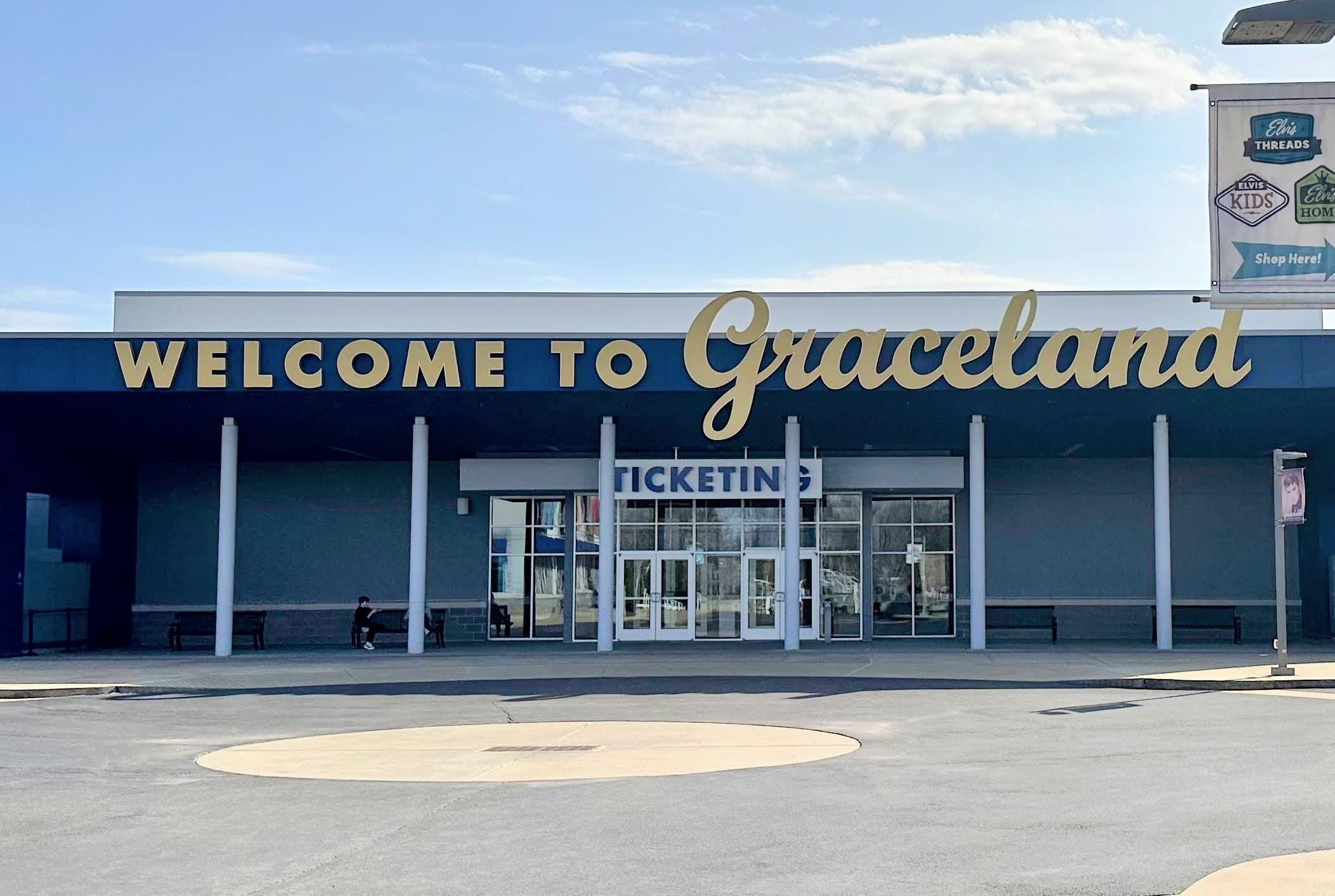
So, Graceland. I have struggled with my response to it, but I will just admit I felt like a complete alien there. I never was an Elvis fan, so I didn’t have the interest others might have in seeing the 15-foot sofa he sat on, the bed his mother slept in, or the 3 TVs he watched simultaneously in his den. For $85, plus $10 for parking, you get to walk quickly through the house juggling a clunky ipad with John Stamos narrating about each room and some of the adjoining areas. Then across the busy road out front, you can wander the acres of gift shops, “museum” spaces with things like Elvis’ board games, record player, and jumpsuits. There is a huge array of vehicles (a snowmobile—?) including two of his airplanes where you go inside and see the deteriorated glitz (“real gold plated seatbelts!”) under heavy plastic sheeting. The style of the decor everywhere seemed purposefully, hilariously, awful, but we were told over and over that it was “a home,” which was said with the reverence that comes with the realization that your adored icon is just like the rest of us in needing a red velvet sofa with white fluffy throw pillows to kick back on. And the whole place had the air of faded, even decrepit, dreariness.
But once I got past all that (all right, I’m not past it at all), what stuck with me was a moment in the racketball building that Elvis had built late in his short life, and where he spent some of his last moments. John Stamos told me that on August 16, 1977, Elvis played a few games of racketball, noodled on the piano in the rec room next door, joked around with some friends, and then went back to the main house, where he died later that night. So standing in that space, we were standing where he unknowingly was at the end of his life.
The next day, we went to the National Civil Rights Museum, the last part of which is actually in the Lorraine Motel. You see the actual motel rooms where Martin Luther King stayed, just after giving his famous “mountaintop” speech. And just like at Graceland, it was the quotidien things like bedspreads and telephones and coffee cups on a tray that brought you into that place and time where King unknowingly spent his last hours. And then you step out onto the balcony and see the window across the street, left slightly ajar since 1968, through which James Earl Ray placed a gun and assassinated King.
Two celebrities, two tragic deaths, two larger-than-life figures with outsize influence. But. All celebrities are not equal, are they? I won’t bore you with my ponderings of why Elvis is called one of the most significant figures of the 20th century, why he has inspired the admiration of everyone from lovesick teenage girls of the 1950s to John Lennon. I am, I admit, not entirely sure what the big deal is. Feel free to remind me that he was a dynamic performer, crossed race and genre lines in his music, and put himself relentlessly in the spotlight. I still am baffled that millions of people a year make the “pilgrimage” to Graceland and come away satisfied.
If Elvis’ fame is a product of sex appeal meets zeitgeist, then Martin Luther King’s celebrity is of an entirely different order. He certainly had a similar force of personality that put him in the center of his moment. But it seems to me that he earned his place in hearts and minds in a way that no movie star rocker could, because he was earnestly and selflessly trying to make a better world. Entertainment is important, but not as important as culture changing. Right?
On our Memphis bus tour were an Australian couple about our age, who were completely baffled by the parts that had to do with Martin Luther King and the Civil Rights Movement. (“What is that name she is saying?” the woman asked me in a low voice. “I never heard of him.”) At lunch we talked a bit with the Aussies about why they were in Memphis: to see Graceland. I said, so you know Elvis, then, and she goggle-eyed me and said “of course!”
In Memphis, we were brought into the last moments of King and The King. I am still working on what it signifies that many more tourists visit Graceland than the Lorraine Motel, what fame in America means and who gets our attention and who doesn’t.
Leave a Reply