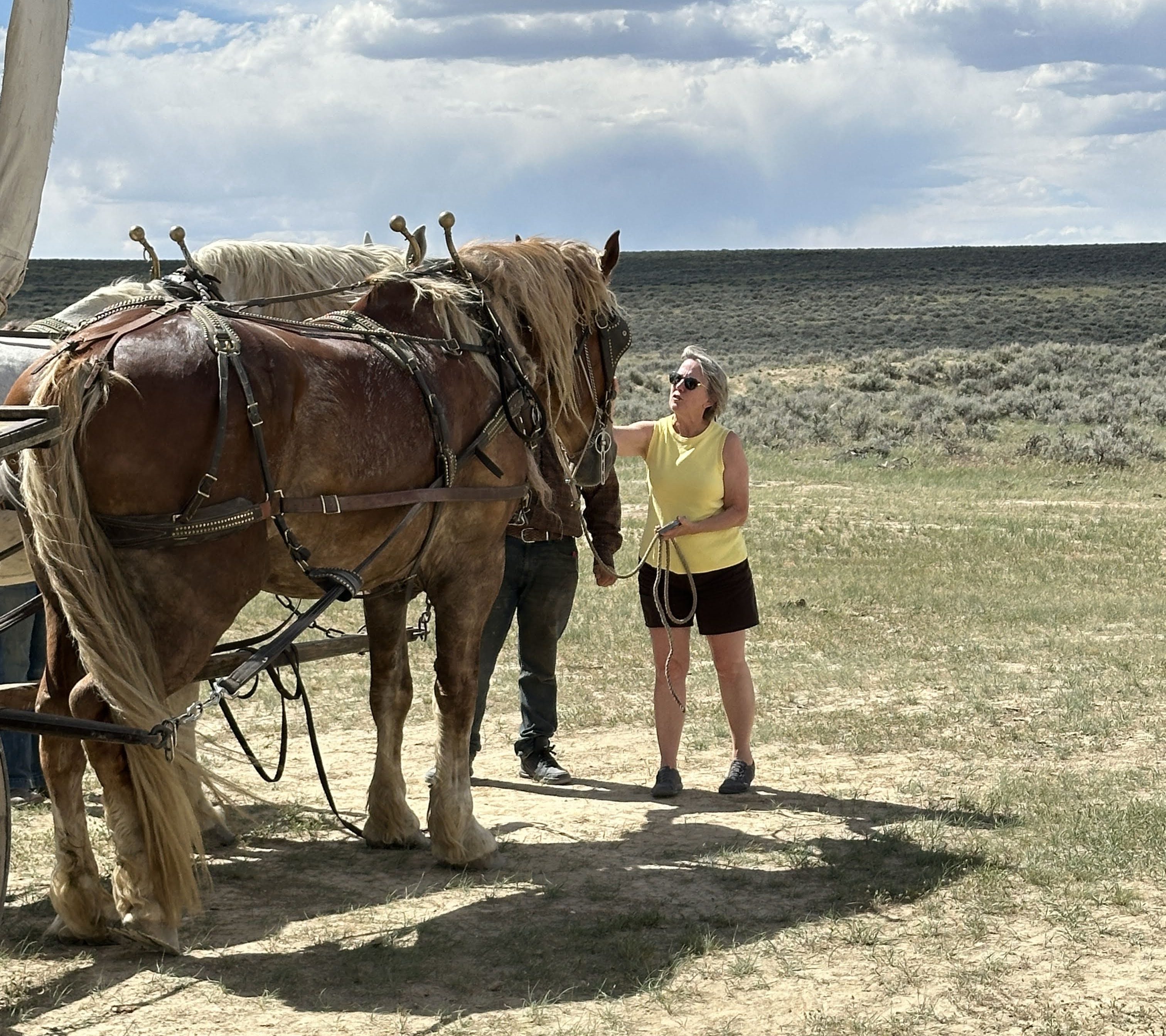
On a hot, dry morning we left the comforts of our highway-side hotel near Casper, WY, and headed west, because any other direction wouldn’t do for what we had planned. We pulled in at Poison Spider School, our appointed meeting place to go to our day’s activity: a covered wagon ride on the Oregon Trail. Even before we got to the trailhead, it was an adventure. Leaving aside the name of the school, the area was almost too Western-movie-cliche, barren and wide open and apparently almost uninhabited. And then there was the conversation with our host Debbie, before we followed in her literal dust down a series of roads that bore less and less resemblance to the modern world, in which she remarked that we were part of a spate of recent guests from the East Coast who were, she surmised, “escaping all the rioting, like in New Jersey.” Amazing how one remark in today’s world tells you everything you need to know about where someone gets their so-called information, and which color tints their politics.
When we got to the unremarkable spot where we were to leave our car and embark, I squealed a little, because the covered wagon was the real deal. So too, it turned out, were the huge horses hitched to it, and the two young people who were in charge of them, and the gravel road (a section of the actual OT), along which we slowly bumped for the next 6 hours. I think it is safe to say that we had a pretty authentic OT experience that day, in fact, because although we didn’t contract dysentery, the food was sparse and not very good, the wagon was loud and the ride was rough, the horses were strong but cantankerous at times, it was hot but the wind never stopped blowing, and the scenery was unchanging and uninspiring. Then, several miles from the end of the return trip, the wagon broke a critical part and one of the guides had to hitch his pony to the back and walk beside to bring the horses back to the starting point. But I am not fooling myself that I know what being a pioneer was really like, as there is no way to really feel that you have experienced life on the Oregon Trail unless you have done all that and worse for six months or more, through all kinds of weather and outrageously difficult terrain.
We had a tourist’s day on the OT, and although we also went to several museums and sites about emigrant life in the American West, including Fort Laramie, the famous Scotts Bluff and the ruts at Guernsey, WY, it’s still hard to fathom what the experience was like for those who were part of the 400,000 people who followed the OT or one of the many other, but less famous, trails that led west. Probably the most useful way to try to understand is through literature.
Growing up in the open farmland of Northern Illinois, I spent vast amounts of time reading pioneer stories. Most of these featured female protagonists, usually teenage girls, who were plucky, strong, cheerful in adversity, and who had helped to make the America that I saw around me as a child: tidy farms and small towns inhabited by independent but community-oriented folks of Northern European extraction. Some of my own family history included Easterners who went West, and we had the handmade coverlet and family Bible they had brought with them to what is now Indiana and Illinois. I always felt it was a shame that I was born a few generations too late because I knew I would have made a great pioneer girl–in fact, I would have been so much better at that than being a girl of the Postwar suburbs, which I didn’t seem to be very good at.
As an adult, I have continued to be fascinated by the lives lived in the midst of manifesting Manifest Destiny, but now my attention has turned more to the adults in those covered wagons, especially the women. And as with so many childhood myths, my notions of pioneers’ cheerful self-reliance began to be reframed by a more historically accurate, if much less delightful, reality. The truth seems to be that although for most men, the OT experience was a larky adventure, for most women, it was terrifying and even deadly. Female experiences like childbirth, battling disease, feeding and nurturing children, not even to mention the absurdly uncomfortable and limiting clothing they wore, made life on the trail and on the frontier a relentless slog. The wonder isn’t that most women suffered untold and unknowable miseries in the American West, but that any of them found the experience to be satisfying at all. As I once mentioned to my dear friend Laura, with whom I read, dissected and discussed the whole tranche of pioneer-woman literature while we were both raising children in the suburbs of the Mid-Atlantic, “I used to think that Ma Ingalls in the Little House books was such a sourpuss, but now I think she is underplaying it.” When Laura died in 1998, so too did the joy in sharing pioneer stories, but I have reopened some of my old-friend volumes this year as we have traveled in the West.
My mother, who opened a world of delight for me by getting me a library card and sharing her favorite childhood books, loved pioneer-girl stories also. She too seemed to find inspiration in books like Caddie Woodlawn and her beloved A Lantern in Her Hand, but I notice that she didn’t introduce me to more nuanced and difficult renditions of life on the prairie like O Pioneers or Giants in the Earth. These last two, unusually, are largely written from a female perspective, and offer rather rare unvarnished views of grim realities rather than gung-ho male versions of settling the West.
While we lumbered along in our covered wagon trip this summer, we had lots of time to get to know our two young guides, because even though we were told we would learn all about the Oregon Trail on our ride, every question we asked was met with “I really don’t know anything about that.” Eventually they handed us a laminated sheet of paper with a few OT facts on it that they were supposed to convey to us as the history portion of the trip, and that ended that topic of conversation. So we talked about their lives in the West. I especially enjoyed chatting with the horse-wrangler extraordinaire who several times kept us from toppling over into a ditch because Mike, the old and possibly hurting member of the horse team, kept pulling the wagon violently off the road, as if he was hoping he could just make the whole ride be over.
Anna, the horsewoman, is 18, and had just dropped out of high school. I hope she doesn’t think I spent the whole ride exhorting her to go ahead and get her GED, but I certainly did mention it a few times. But as we talked, she gave me insight into the life of one particular young woman of the Wyoming plains in the 21st century, maybe some things that would please her forebears who suffered so much to get to and settle that area. She admittedly hasn’t traveled much, but she is deeply tied to her region of the country. She loves working with horses and all she wants is to own a few and a small ranch one day (high school diploma not seemingly necessary). She remarked on the beauty of a landscape that I had found desolate, and seemed perfectly content to sit with two older people from Virginia for six hours and plod along the open road under the steely Wyoming sky.
Anna is a girl of the West, happy to be there and with the very relevant skills of handling horses and a rickety covered wagon, along with managing the things that can go wrong on the Oregon Trail, even on a 21st-century tourists’ day out. When the part fell off the wagon, my first question was “who can you call to come help and take us all back to the trailhead?” Her answer was that there was literally no one to call. She was too polite to say so, but we were on our own, and she would figure it out. And she did. I guess plucky and self-reliant girls on the American frontier are not fiction after all.

Our wagon, ready to set out for parts unknown (to us) 
Although most emigrants on the OT walked alongside the wagon for all those miles, we got to ride 
Anna, our trusty driver 
Poison spider, poison springs…this area isn’t for the faint of heart 
An original OT marker along our route 
Register Cliff, where travelers inscribed their names and dates: it’s a movingly tangible record of their presence 
Original OT wagon ruts, worn deeply into the rocks by the 100,000 wagons passing through, near Guernsey, WY 
Guernsey, WY, today: still feels like the Old West of legend
Leave a Reply