Reflecting on 50 years together in the Semiquincentennial

Later this week we’ll be traveling to Williamsburg, where our first date occurred exactly 50 years ago and where so many “firsts” for our country also took place. Having laid the foundation for our plans for the year, we thought we’d share a bit about how we got to that “land of firsts.”

Dianne:

I have a memory that may not be completely accurate, but which has nevertheless become a foundational part of my story.  Sometime in my early teens, my family was in Williamsburg as part of a vacation on the East Coast.  I remember three specific things about that moment.  The first was the sticky heat that made standing in line outside the historic buildings in Colonial Williamsburg an exercise in stamina and forced perkiness, as wafts of air conditioning oozed out each time the door was opened to let in the next group.  My second memory is of falling viscerally in love with Williamsburg: the tidy historic buildings and gardens, of course, but also the details like the delicious straw hats in the millinery shop, the gates with cannon-ball-like weights on chains that made them close with a soft colonial-sounding thud, and the profusion of candlesticks, petticoats, baskets, and all manner of quaint material culture.  

The third memory may have been the most life-changing (and also possibly the least accurate).  Standing in the middle of the Duke of Gloucester Street, enamored with everything I saw, I remember hearing my father mention that there was a college in Williamsburg.  There–at the other end of the street.  See it?  That brick building?  

Well, that did it.  From then on, ask anyone in my suburban Chicago high school class, I was bound for the College of William and Mary, no matter how outside the bounds of Northern Illinois normalcy that was.  

The town I grew up in wasn’t really a suburb, it was a small town on the Fox River, a straight shot 40 miles west of the Chicago lakefront.  It’s important to understand how new everything there was.  Since the area was opened to American settlement nearly halfway through the nineteenth century, our sense of history was not deep.  Lincoln, of course, but also pioneer homesteaders, Scandinavian immigrants, and a sprinkling of overly romanticized stories of Indigenous people.  If I thought about it at all, and to be honest, I didn’t very much, history didn’t really exist in real life, only in the books I spent an outsized amount of time devouring.  

I went to schools that had just been built–one of my elementary schools was basically under construction when I first arrived–and the nucleus of downtown St. Charles along the river was constantly being enlarged by new construction out into the surrounding cornfields.  My parents built a house on an acre of woods in a brand-new neighborhood called Wild Rose Valley.   

But there was also clearly a hunger for history.  Our house, like almost everyone else’s I knew, was “colonial” style (in our case, something called “Garrison Colonial,” having a slightly overhanging second floor as an echo of New England houses of the 17th century).  And the interiors were 100% nostalgia, although everything was new.  My mom bought a cherry dining room set in a vaguely Georgian mode; the wallpaper had drums, eagles, and weathervanes; there were rag rugs, pewter candlesticks, barrels as trash cans, and hobnail bedspreads.  I didn’t know it at the time, but it was all Williamsburg, all the time, which may help to explain why, when we got to the reconstructed colonial capital of Virginia in the late 1960s, it felt like, well, home.  

At the time I didn’t examine any of this on a deep level, and in fact it has been the project of a lifetime to think about how a midwestern girl got to Williamsburg in September 1975 as a freshman at the College of William and Mary, and why that arrival felt like both a branching out into a whole new world and also a comfortable, familiar place to start a new life.  

Joey:

I had a head start on Dianne in getting to the ‘Burg. I went first as a 4th grader studying Virginia history. I later spent a week there as a participant in Boys’ State, a gathering of 1-2 guys from every high school in Virginia focused on civic engagement and public service. I traveled there many times with my father, who had a contract with Colonial Williamsburg to service all of the fire extinguishers throughout their complex. And my parents had taken me there on a few occasions, as we had relatives who lived in Williamsburg. We only lived an hour and a half away, so it was never a major trip

But, to be honest, none of those connections played much of a role in my applying to William and Mary. At that time, W&M was the best school academically in Virginia, and since I could only afford in-state tuition, I wanted to get the best education I could for my investment. The choice was easy and it was the only college I applied to–fortunately I was accepted. It wasn’t an “Aha!” moment like Dianne’s, or an obvious life-changing dream, but nothing about my experience there ever made me second-guess my choice–meeting Dianne there was the perfect capstone to an amazing adventure, and the start of a brand new one.


8 responses to “Getting to the Beginning”

  1. darkb1583202c8f

    Nice entries! We did a family thing stopping in Colonial Williamsburg back in the early 60s when I was a kid, and I don’t remember much at all from that, other than, yes, it was insanely hot, there was a little stream behind some shops and I figured it must be cooler back there, and we saw the blacksmith’s shop in action for a bit. I’ve read that William Small, when teaching TJ at W&M back then, wrote back to his Brit connections that the heat and humidity there was ‘beyond belief.’ Note that when he got the chance to get back to England to buy scientific equipment, he managed to never return to VA. We must have bought tricornered hats as well. My sister actually applied to W&M years later, and was denied! So she went to Davidson instead. I always hear that W&M led the nation in suicides, and there was of course the famous line about their football team back in the day: “William’s no good and Mary can’t play.” That was before Title IX, though.

    I’ve actually only returned there surprisingly few times though I really like the place. Once my very first year as a guide on a field trip with, yes, Gary Sanderling, but we got a behind the scenes tour of their curatorial and restoration buildings (before the place almost went belly up bankrupt…) and a few years later in December to meet some now ex-Monticello guides who were renting cottages for the night there and I was just for the afternoon, but I lingered that winter afternoon til the gloaming, and got a shot of a red tail hawk sitting in a low bough of a big oak right beside the Capitol. That must have been the same winter day where I had a superb tour of the George Wythe House by a truly excellent, intelligent guide, the introduction having begun in a room by a warm crackling fire (which I will not have in 30 degree weather giving a tour tomorrow. Think Monticello might get a useful idea from somewhere else? Not bloody likely). And I went once with… Brad Rovanpera!, who talked my ear off. That time got one of the worst tours I’ve ever endured in the Guv’s Palace by a ‘period’ guide. She was deplorably, inexcusably bad. A young lady working the Armory in full military regalia told us she wanted to see Monticello, but couldn’t afford our admission cost. Such is our reputation even among the museum world.

    And then there was the overnight guide’s field trip in 2019 led by Bill Barker, who as yet wasn’t working at Monticello, great fun, where Susan Kern gave us an impromptu talk that wasn’t even planned in a tour of the Wren Building (sorry, not by Wren…), and we finally got to see the Apollo Room (Live at the Apollo!) in the Raleigh Tavern which had never been open in my earlier visits. Legedarily, the guides emptied Bill Barker’s liquor cabinet in his cottage on Duke of Gloucester St. I politely abstained besides the smallest of samples.

    I’ve got tons of photos, of course, including one of Jacqueline obligingly kissing the foot of the statue outside of the Wren Building (is it TJ? I can’t even remember now) as she swore it gave one good luck (or Hoof & Mouth disease, I’ve always thought). You’ll have to tell me if that myth is true or not, but as devoted a W&M grad Jacqueline is, it must be true.

    Have a great weekend there! The Brunswick Stew is always a decent choice in wintertime.
    D.

  2. darkb1583202c8f

    P.S. DarkB etc. seems to be my ID here, Don McCracken

  3. eleganttreeb93f33b8be

    I remember Dianne, you talking about falling in love with CW on a family trip, and that it was as much a dream for you to go to W&M as it was a departure from the norm in your high school for you to come so far away. You saw yourself as a renegade of sorts it seemed, and you liked that image of yourself. That’s how I remember it. Does that feel accurate?

    1. DPintheUS

      Wow—amazing that you remember that, Meg! I don’t know that I have ever felt like a renegade (more’s the pity), but I did feel very sure of my W & M decision. And meeting you there was a delightful outcome.

  4. limburgermagical8a0a41b100

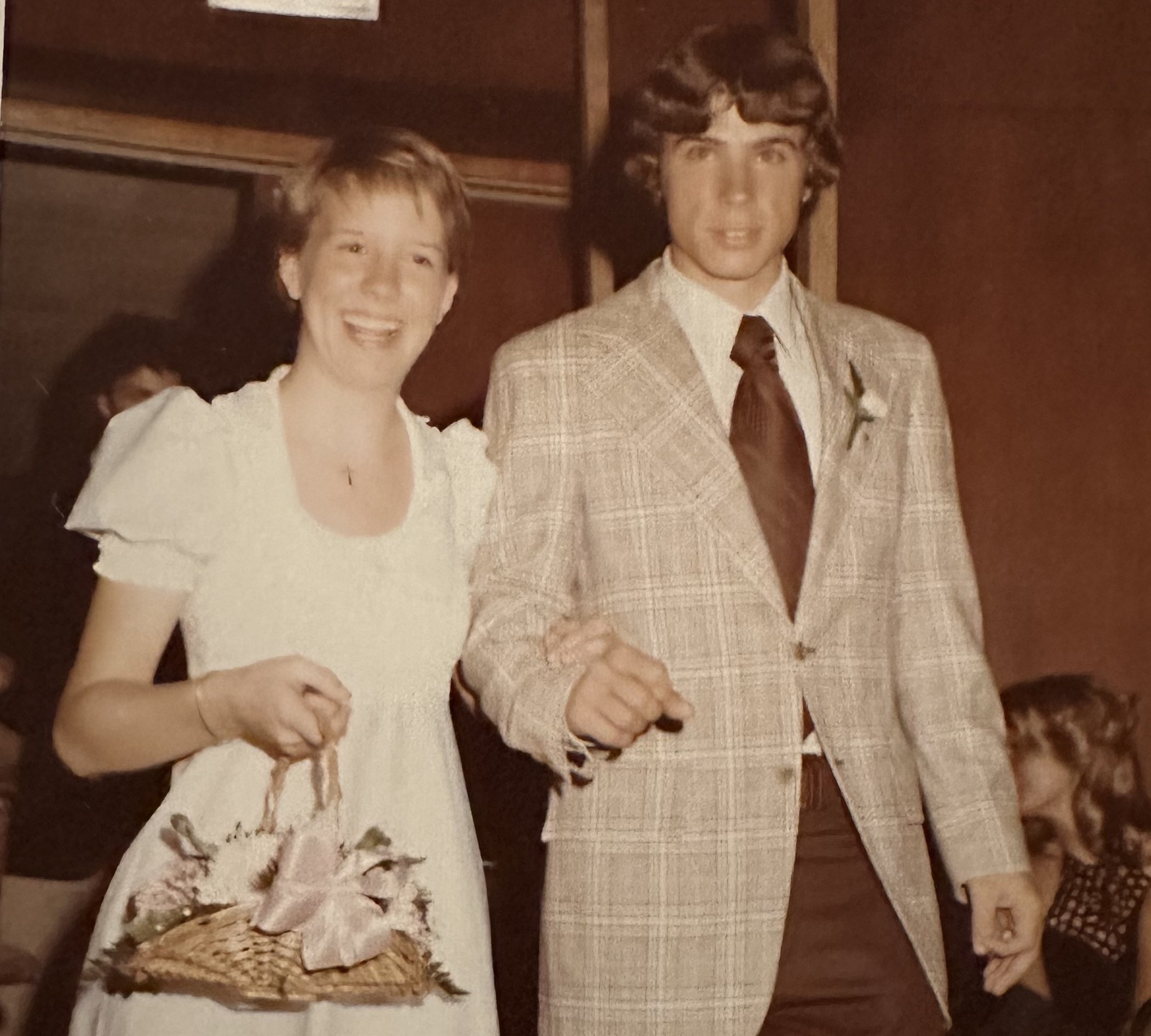
    Dianne and Joey … it was kismet! And that wedding photo has a cuteness factor that’s off the charts. 🙂

  5. DPintheUS

    Aww, thanks, Danna! Not our wedding, but a sorority pledge dance—the same young wide-eyed optimists, for sure.

  6. bethpnyc

    Dying. I love all this so much. And wow, what I’m learning about my dear friends ….

  7. Lee

    This is my favorite so far!! So personal and charming. Your Mom’s decor at the time was so ubiquitous, eh? Talk about the search for an American aesthetic. At least you didn’t have old farm implements hanging from a beam in the kitchen like my mother. OK. Here is a youTube clip that is too pertinent.
    https://www.youtube.com/watch?v=iNDXBa9d-8w
    (It may not be clickable, but I’ll send it to your email, too. Mentions of CW in TV shows! Hilarious)
    xoxo

Leave a Reply

We’re Dianne and Joey Pierce and we’re on a journey to rediscover America. Travel with us as we celebrate 50 years together by exploring 50 places and themes that connect the story of America with our life together.