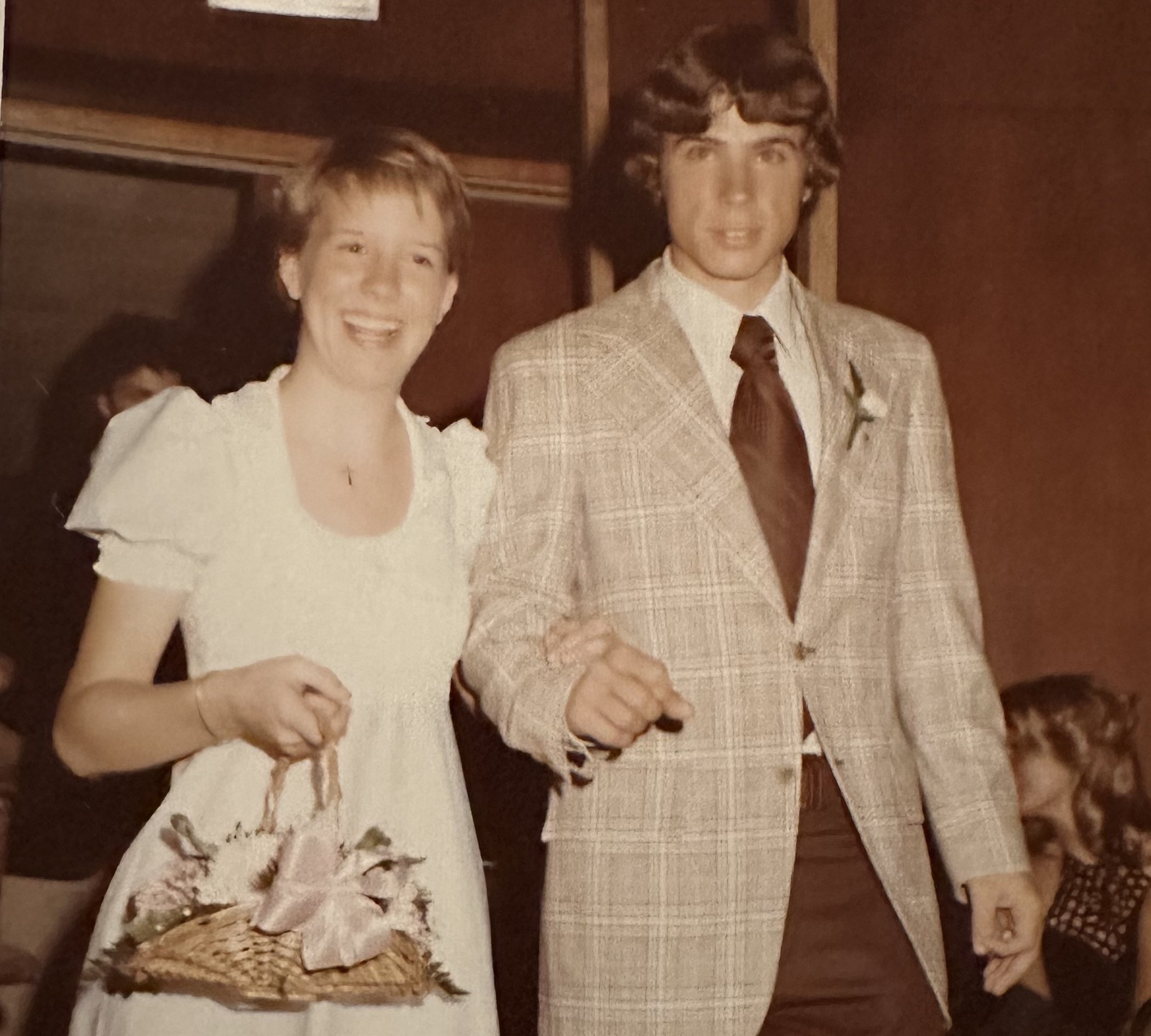
Later this week we’ll be traveling to Williamsburg, where our first date occurred exactly 50 years ago and where so many “firsts” for our country also took place. Having laid the foundation for our plans for the year, we thought we’d share a bit about how we got to that “land of firsts.”
Dianne:
I have a memory that may not be completely accurate, but which has nevertheless become a foundational part of my story. Sometime in my early teens, my family was in Williamsburg as part of a vacation on the East Coast. I remember three specific things about that moment. The first was the sticky heat that made standing in line outside the historic buildings in Colonial Williamsburg an exercise in stamina and forced perkiness, as wafts of air conditioning oozed out each time the door was opened to let in the next group. My second memory is of falling viscerally in love with Williamsburg: the tidy historic buildings and gardens, of course, but also the details like the delicious straw hats in the millinery shop, the gates with cannon-ball-like weights on chains that made them close with a soft colonial-sounding thud, and the profusion of candlesticks, petticoats, baskets, and all manner of quaint material culture.
The third memory may have been the most life-changing (and also possibly the least accurate). Standing in the middle of the Duke of Gloucester Street, enamored with everything I saw, I remember hearing my father mention that there was a college in Williamsburg. There–at the other end of the street. See it? That brick building?
Well, that did it. From then on, ask anyone in my suburban Chicago high school class, I was bound for the College of William and Mary, no matter how outside the bounds of Northern Illinois normalcy that was.
The town I grew up in wasn’t really a suburb, it was a small town on the Fox River, a straight shot 40 miles west of the Chicago lakefront. It’s important to understand how new everything there was. Since the area was opened to American settlement nearly halfway through the nineteenth century, our sense of history was not deep. Lincoln, of course, but also pioneer homesteaders, Scandinavian immigrants, and a sprinkling of overly romanticized stories of Indigenous people. If I thought about it at all, and to be honest, I didn’t very much, history didn’t really exist in real life, only in the books I spent an outsized amount of time devouring.
I went to schools that had just been built–one of my elementary schools was basically under construction when I first arrived–and the nucleus of downtown St. Charles along the river was constantly being enlarged by new construction out into the surrounding cornfields. My parents built a house on an acre of woods in a brand-new neighborhood called Wild Rose Valley.
But there was also clearly a hunger for history. Our house, like almost everyone else’s I knew, was “colonial” style (in our case, something called “Garrison Colonial,” having a slightly overhanging second floor as an echo of New England houses of the 17th century). And the interiors were 100% nostalgia, although everything was new. My mom bought a cherry dining room set in a vaguely Georgian mode; the wallpaper had drums, eagles, and weathervanes; there were rag rugs, pewter candlesticks, barrels as trash cans, and hobnail bedspreads. I didn’t know it at the time, but it was all Williamsburg, all the time, which may help to explain why, when we got to the reconstructed colonial capital of Virginia in the late 1960s, it felt like, well, home.
At the time I didn’t examine any of this on a deep level, and in fact it has been the project of a lifetime to think about how a midwestern girl got to Williamsburg in September 1975 as a freshman at the College of William and Mary, and why that arrival felt like both a branching out into a whole new world and also a comfortable, familiar place to start a new life.

moments suffusing my childhood


Joey:
I had a head start on Dianne in getting to the ‘Burg. I went first as a 4th grader studying Virginia history. I later spent a week there as a participant in Boys’ State, a gathering of 1-2 guys from every high school in Virginia focused on civic engagement and public service. I traveled there many times with my father, who had a contract with Colonial Williamsburg to service all of the fire extinguishers throughout their complex. And my parents had taken me there on a few occasions, as we had relatives who lived in Williamsburg. We only lived an hour and a half away, so it was never a major trip
But, to be honest, none of those connections played much of a role in my applying to William and Mary. At that time, W&M was the best school academically in Virginia, and since I could only afford in-state tuition, I wanted to get the best education I could for my investment. The choice was easy and it was the only college I applied to–fortunately I was accepted. It wasn’t an “Aha!” moment like Dianne’s, or an obvious life-changing dream, but nothing about my experience there ever made me second-guess my choice–meeting Dianne there was the perfect capstone to an amazing adventure, and the start of a brand new one.
Leave a Reply