There are two ways to visit Montgomery. You can stop at Buc-ee’s on the drive in (which we did) and marvel at the infinite line of gas pumps, the sparkling restrooms, and the rows upon rows of every snack you can imagine. You can visit the Scott & Zelda Fitzgerald Museum and see the last place where the Fitzgerald family lived together (we didn’t). And you can go to the Riverfront area and dine in one of the new eateries, stay in one of the new downtown hotels, and then jump back on I-85. Or…
You can go to the Equal Justice Initiative sites, including the Legacy Museum, the National Memorial of Peace and Justice, the Freedom Monument Sculpture Park, and the Elevation Convening Center (we did). As the EJI website says, “The power of history is in telling the truth,” and the sites attempt to tell a full, comprehensive history of how Blacks have been treated in America. Not just so that we “intellectually know” what has happened and continues to happen, but so that we “experience” what has happened and continues to happen. And by doing so, EJI, and Montgomery, are helping us reckon with the oppressive and violent side of American character and culture.
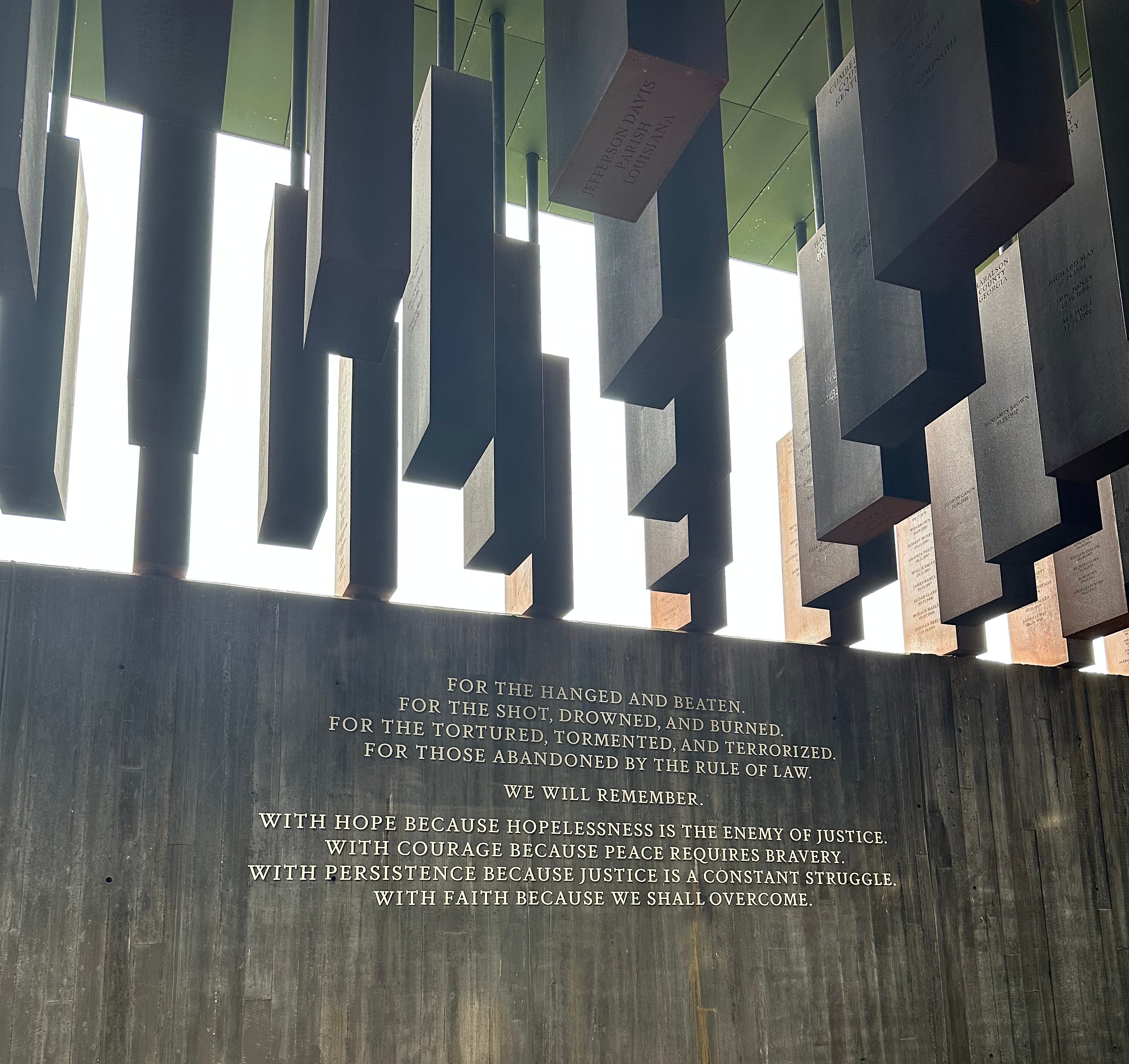
It’s not easy to visit the EJI sites. The Museum, through its dark, dark interior, its intense narration, and its sensory-immersed exhibits, shares the horrors, the brutality, and the violence of ripping over 12 million human beings from their homes and villages in different parts of Africa and trafficking them to the Western Hemisphere, then treating them as property, all to enrich the white landowners here. It brings to life the plantation system, the Civil War, Reconstruction and its broken promises, Jim Crow suppression, the Civil Rights struggles, and the mass incarceration of Blacks. The National Memorial of Peace and Justice depicts in startling fashion the thousands of Blacks lynched, massacred, and brutalized by whites, primarily in the South but in nearly every state, in deliberately violent acts to intimidate the rest of the Black population. It’s heartbreaking and soul-crushing.
The National Memorial was designed by MASS Design Group, a nonprofit architectural firm in Boston committed to using design to speak the truth, to tell the untold stories, and to encourage abundance, for the individual, the community, and our world. I’ve had the wonderful opportunity to know the founders of the firm and even to work with the firm recently, and I strongly encourage you to check them out, especially their recent convening on Abundant Futures–so inspiring!
It is hard, and perhaps impossible, for most white people today to really come to grips with the attitudes and actions of the slaveholders, or those who passed the Jim Crow laws throughout the South, or those who firebombed Black churches and homes and businesses, or those who rioted rather than attend integrated schools. And yet we must, for in many cases those perpetrators were our fathers and grandfathers and great-grandfathers. The oppression and the violence are, unfortunately, part of our DNA as a country.
The racial discrimination continues today. The mass incarceration of Blacks; the so-called “war on drugs” which targeted Blacks; the deliberate destruction of Black neighborhoods and communities through public projects; the intimidation, abuse, and even killing of Blacks by police–all are recent expressions of this same oppression and violence.
Montgomery, once one of the largest slave markets in the South and the site of so many dramatic actions in the civil rights movement of the 1950’s and 1960’s (think Rosa Parks, the bus boycott, the Freedom Riders, etc.), is helping us reckon with the dark side of America by telling the truth about it to all who will listen. Dianne, in her slavery tours at Monticello, helped visitors reckon with the stain of slavery by telling the “complicated story” of Thomas Jefferson as both author of our Declaration of Independence and enslaver of hundreds. MASS, through its National Memorial and many other projects, is telling the story of white American oppression of Blacks, Native Americans, and many “others.” These aren’t easy stories to hear, and it’s even harder to come to grips with our roles in them.
At the National Center for Civil and Human Rights in Atlanta, we heard much of the same story, though not quite so graphically told. One aspect of the story, however, focused on the rights of all human beings, captured in the Universal Declaration of Human Rights, drafted in 1948 by the UN and eventually adopted by EVERY country participating in the United Nations. These principles represent a “common standard of achievement for all peoples and all nations.” Even though ratified by so many countries, the Declaration has been fully implemented and honored by a very few.
At the end of our visit to the Center, we stopped in an area described as the “Action Lab,” a space intended primarily for kids but so appropriate for every adult. Here’s how it is described:
The Action Lab is a space for reflection, discovery, and next steps. Here, visitors can identify their personal approach to changemaking, connect their passions to real-world issues, and explore tangible ways to take action. Whether you’re just getting started or looking to deepen your impact, the Action Lab invites you to move from awareness to engagement with tools, stories, and pathways grounded in purpose.
While in Montgomery, we spent time with Jocelyn Zanzot and Daniel Neil, multi-faceted professionals using urban and landscape design, planning, and historical research to create “tangible ways to take action.” In addition to taking us on a driving tour of some key sights in the city, they shared some of their many projects with us, including writing local highway markers and a new concept related to the route of the civil rights march from Selma to Montgomery and the campsites involved. Jocelyn and Daniel personify the Action Lab and we hope to be part of some of their future work.
Reckoning with our past, and with our present, going beyond rational awareness to deep experience, is a hard, challenging, and perhaps life-time effort. Dianne and I are still very much processing all that we have seen and heard in the last few days, in Atlanta, Montgomery, Birmingham, and now in Memphis, where we are staying across the street from the Lorraine Motel, where Martin Luther King was assassinated. We are grappling with our role in this oppressive and violent country, and we are seeking to discern appropriate next steps. It’s a critical journey, for us and for America.
Equal Justice Initiative–Legacy Sites website: https://legacysites.eji.org/
Clint Smith wrote an incredible article in The Atlantic called “Those Who Try to Erase History Will Fail” which shares a deeper look at two of the EJI Legacy Sites. I encourage you to read it. Thanks for sharing this, Elizabeth!
https://www.theatlantic.com/ideas/2026/01/slavery-museums-black-history-lynching/685660
MASS website: https://modelofarchitecture.org/ I especially encourage you to visit the Abundant Futures pages and listen to some of the talks.
Leave a Reply