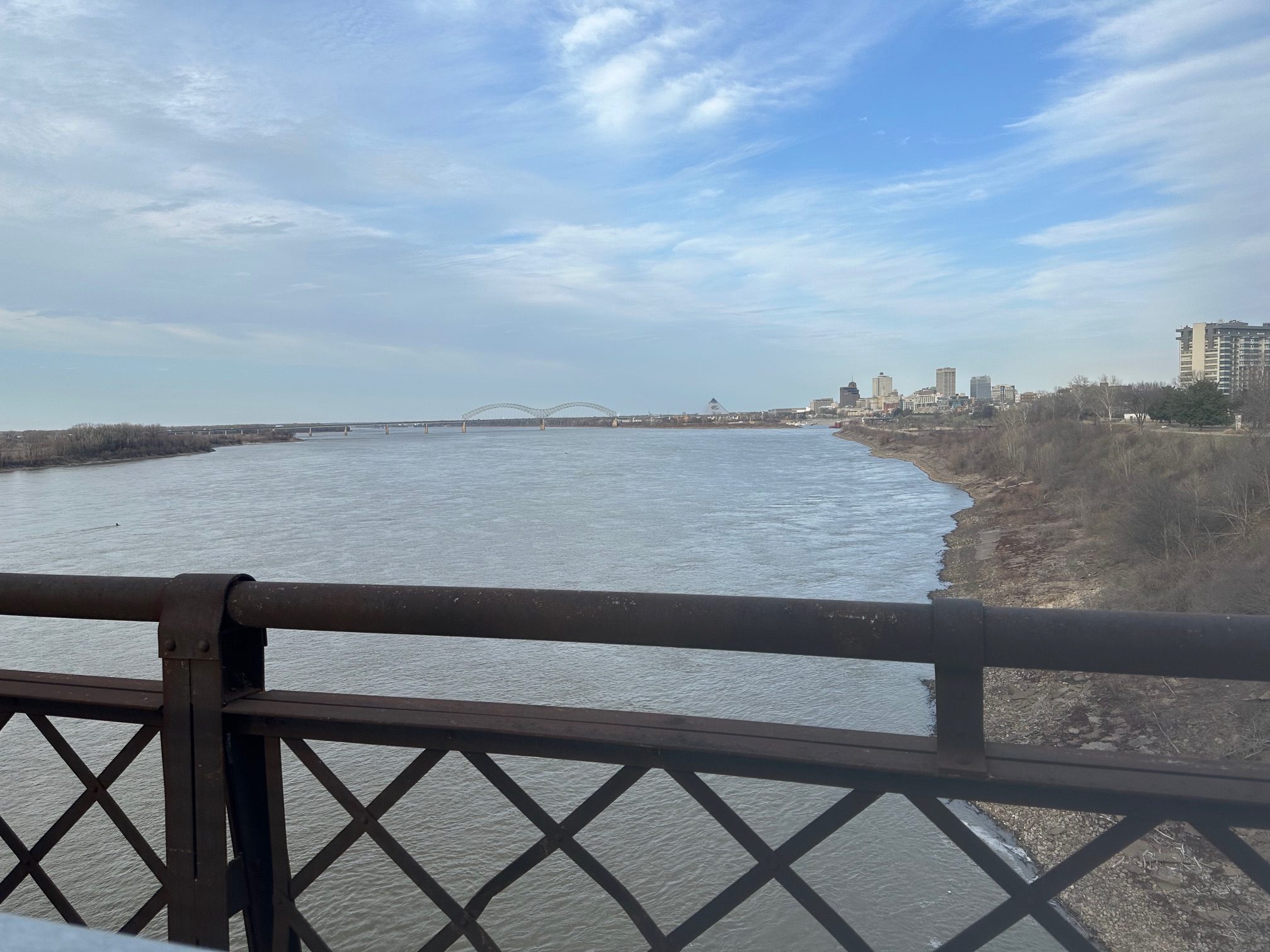
“The face of the water, in time, became a wonderful book—a book that was a dead language to the uneducated passenger, but which told its mind to me without reserve.”
–Mark Twain, former steamboat pilot, speaking about the Mississippi River
Traveling from Memphis to New Orleans, we followed the Mississippi River, seeking to experience and understand the mind of the river and the influence of that great resource on America. The second longest river in the country (only the Missouri is longer), and with a basin that includes 31 states, it has had a major impact on the development of the United States and continues to be a significant driver and carrier of the American economy. While Memphis, Vicksburg, Natchez, and New Orleans (cities we visited along the way) all have their unique histories and characteristics, all developed primarily as river and trading posts and still today rely on the river for much of their vitality.
Dianne and I are more lake people than river rats. Our personal experience of rivers stems primarily from living for two years on Roosevelt Island in the middle of the East River, which flows into the Hudson River in New York City just a mile further downstream. From our apartment window I could watch the boats, big and small, float by, sometimes spending an hour or more just watching, thinking, imagining. From our roof deck at night we would view not only the skyline of Manhattan at sunset but also the lights of the boats below, dancing up and down, reflected on the ripples of the waves created by the vessels. The Hudson was perhaps the greatest natural resource facilitating American economic growth in the first 200 years of our country, so we were quite interested to see how the Mississippi compared.
Unfortunately, “seeing” the Mississippi proved a bit of a challenge. While we could get views of the river in each of the cities, driving alongside the river between cities revealed a vision of only continuous levees that run almost the entire length of the river–not what we hoped for as we ventured off the interstate. The levees looked like a large grassy mound, but the consistently smooth finish and height of the mound made it clear that it was man-made, not natural. At a height of 10, 15, or 20 feet above river level, the levees blocked our view completely. In the cities, when we did finally see the actual water, the Mississippi didn’t actually appear all that mighty. It wasn’t particularly wide, it was meandering, muddy, and there was no “roaring” as it flowed past. Clearly, there must be more to the mind of the river than appeared to this uneducated traveler.
Historically, the river has been multi-cultural, as claims to the Mississippi and its basin shifted a number of times over the centuries, from the Native Americans to the French to the Spanish back to the French then to the British and ultimately to the new United States. The river frequently served as the boundary between countries in the early jockeying for territory within North America by Europeans. In 1803, the U.S., which extended to the eastern bank of the Mississippi as a result of the Treaty of Paris ending the American Revolutionary War, purchased much of the land west of the Mississippi from Napoleon, even though he had committed to return it to Spain.
After the land purchase and the Lewis and Clark expedition, the Mississippi served as the boundary between U.S. territories and ultimately new states. The issue of extending slavery into these new territories and states was one of the immediate causes of the Civil War, and the river was also a key factor during the war. Both the Union and the Confederacy understood the importance of controlling the river, primarily for the ease of moving troops and supplies. General Grant was charged with the task of gaining control of the river for the Union. It took a couple of years, many attempts, and significant loss of life for the North to gain full control, with Vicksburg the last fort to fall after a devastating 47-day siege and constant bombardment. Securing the river was a turning point in the war, as Grant was promoted to General-in-Chief of all the Union army and turned his focus to the eastern campaign, while Sherman was ordered to ravage his way to Atlanta and other key Southern cities and towns.
Control of the river shows up in other ways today. The previously mentioned levees along the river are an attempt to harness its frequent flooding. Some of the early levees weren’t sufficiently tall, and in 1927 there was massive flooding, inundating thousands and thousands of square miles of farms and towns. One of the results of that flood was the creation by Congress of the Army Corp of Engineers and the construction of a much higher levee, now stretching 2,200 miles along the river from southern Illinois to the Gulf of Mexico, a truly spectacular engineering and construction accomplishment.
There are other claims to the river and fights over control. Transportation on the river, particularly of agricultural products from the Midwest, is still a high priority, as river transport is dramatically cheaper than rail or trucking alternatives. A single barge on the river can move 1,000+ semi-truck loads of goods at a fraction of the cost. Recreational use–fishing, boating, kayaking, wildlife viewing–of the river is growing, but delineating safe, protected places along the river is challenging. Wildlife is suffering, as development along the river destroys marsh and other habitat. Industrial manufacturing, especially industries that require water either for cooling or for cheap transportation, has taken over many sites along the river, limiting access. Today, petrochemical plants are sucking up much of the riverfront, especially the further south you go. Since such plants bring jobs and profit, other uses are finding it hard to compete; unfortunately, such plants also lead to environmental degradation, and the effects are becoming more obvious. In New Orleans, where we ventured out into the bayou on a fan boat tour, our guide was adamant and disgusted in saying that the politicians there “don’t give a shit about the environment.” The battle for control of the river is intense.
The Mississippi continues to be a mighty factor in the American economy. Hundreds of millions of tons, and hundreds of billions of dollars, of cargo travel on the river annually, including approximately 60% of U.S. grain exports, as corn, soybeans and wheat from Iowa, Minnesota, Illinois and Kansas float to the Gulf for shipment though the Port of Louisiana to the rest of the world. The river is perhaps our most important commercial highway.
But the river also reflects so many of the major challenges associated with America’s natural resources. Are the resources to be maximized for private profit, or do they belong to the public good? Should they be developed and perhaps used up, or preserved and limited for public benefit and for future generations? What are the long-term implications of destroying natural habitat and marsh areas, not just for wildlife but also for human life? What happens when we upset the ecological balance–doesn’t history teach us that unforeseen consequences usually occur? America is blessed with so many natural resources and much inherent beauty. Are we taking those resources for granted, abusing them, depleting them, all in the pursuit of capitalism and more profit, or will we learn from past abuses and become better stewards? These same questions get asked time and time again, and the argument never seems to be resolved. What’s good for GM is good for America, so we believe…until it isn’t.
As we left New Orleans to explore the Gulf Coast, I was conscious that I hadn’t had a Huck Finn moment on the Mississippi. I had learned a lot (and I’ve shared with you a lot of that learning–sorry), but I hadn’t actually experienced much as a result of being on or near the river. I hadn’t had that “Aha!” deep-down feeling, or that take-your-breath-away vista, that I’ve had on the Hudson. I’m not aware of a “Mississippi River School” of painting. Perhaps that’s the nature of the Mississippi–vitally important in the grand scheme, but underwhelming in the moment. Or perhaps I’m just another “uneducated passenger.”
Leave a Reply