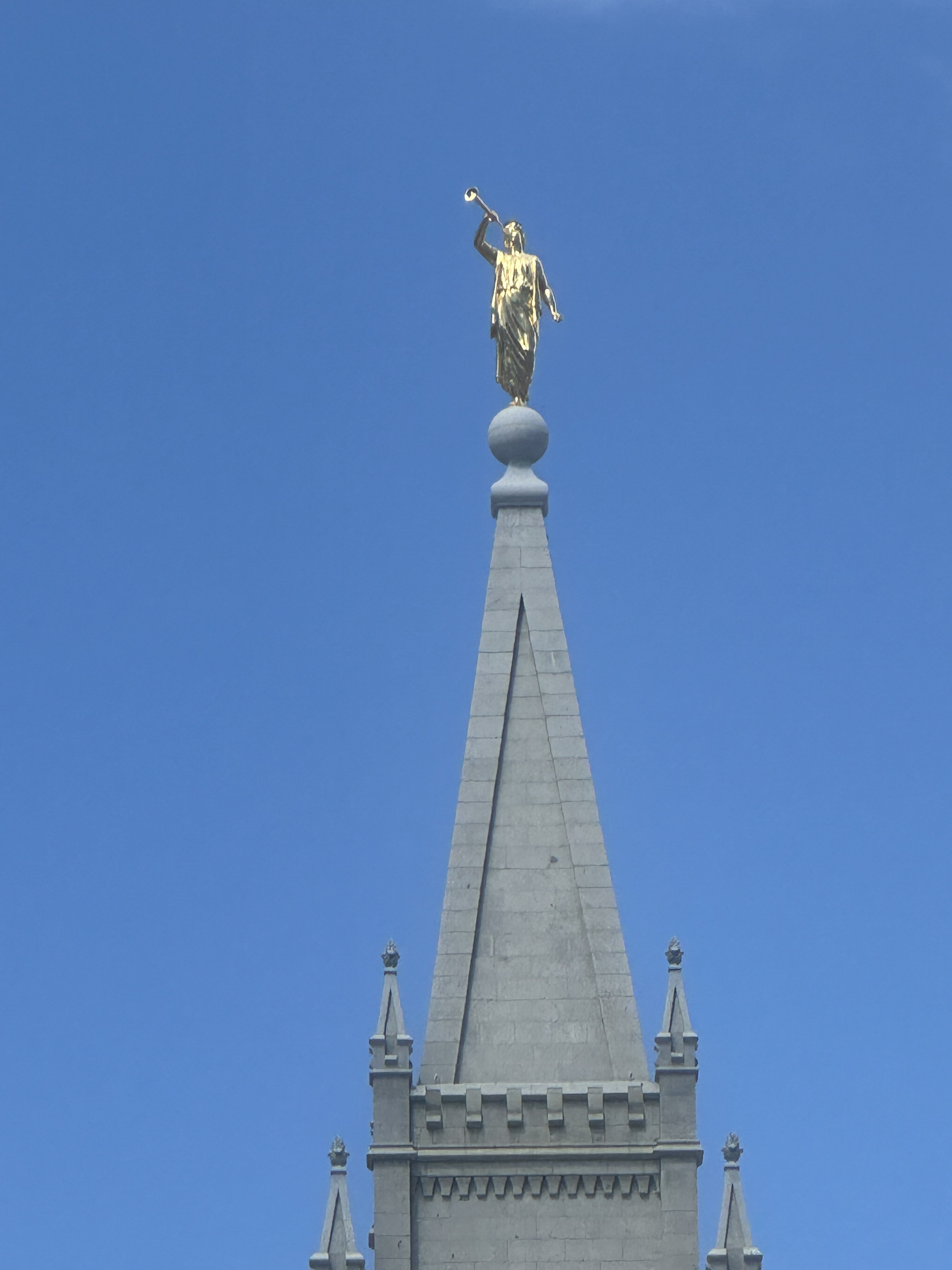
Approaching Salt Lake City, I expected to see the spires of the shining white Temple dominating the view. But we didn’t see the Temple or the Tabernacle until we took a downtown walking tour the following morning. What we saw first was the spectacular Natural History Museum of Utah, a tour de force of Native and pioneer history, the Mormon story, and, yes, dinosaurs. We took a walk along a beautiful multi-use trail that encircles the city, and began to really enjoy the vibe of SLC, in spite of yet another rattlesnake encounter right in the middle of the heavily-used path. (If I hear one more time how snakes hate people and will always steer clear of us….)
As we went to our downtown soulless corporate condo for the night, we began to notice something else. The city and the areas around it are clean, like eat-off-the-sidewalk clean. Tidy, litterless, and spotless. The next morning, on our walking tour with grad student guide McKenna, we learned a lot about the city’s history, including how the railroads built elegant stations and hotels to compete for the burgeoning Western travel business, and how the modern city has a strong public arts program, diverse population, and surprisingly liberal culture. McKenna also mentioned that businesses like window-washing, corporate office cleaning, and sidewalk repair are incredibly lucrative in Salt Lake City. As the tour concluded at the city centerpiece, Temple Square, some things coalesced for me. I don’t pretend to have deep knowledge of the Mormon (Church of Jesus Christ of Latter-Day Saints or LDS) faith, but it seems that Salt Lake City is in many ways a physical representation of LDS ideas and the history of this sect.
Clean living, wholesome family-centered community, and an emphasis on hierarchical governance create dazzling white buildings arrayed around perfectly manicured landscapes in a city where LDS-funded civic improvements are similarly immaculate, and even vacant lots and public trash cans look respectable. Carefully rehabilitated historic buildings demonstrate LDS’ reverence for history, while parks with elaborate playgrounds indicate the centrality of the nuclear family. The concept of virtuous living meant that for much of its history, Salt Lake City had no bars, or even tea rooms or coffee houses. A Wild West town without saloons, brothels, and regular shootouts? It must have been a sight to behold. Now those vices (minus shootouts and brothels) are allowed in SLC, but the historic commitment to rectitude still lingers. Ideals like commitment to civic and global causes are harder to see, but the neatly dressed “brothers” and “sisters” walking around Temple Square asking in multiple foreign accents if they can answer any questions about Mormonism certainly speak volumes. While many cities have historic preservation projects and show civic pride, I have never seen a city that has ideology and theology so prominently displayed.
All of which got me to thinking about control. Because it takes control to make places this spit-polished. Do the Magic Kingdoms and nostalgic Main Streets of Disney parks happen by chance? No, it’s a tightly controlled environment, and like Salt Lake City, it’s so clever and appealing that you almost forget the men behind the curtains who are creating and maintaining these places.
The history of the LDS Church is a very American story, with similarities to the Puritans and many other groups who have sought freedom on this continent, only to find that freedom leads to tricky issues of who gets the freedom and who doesn’t, and most of all, who is in charge of all that freedom. Also known as struggles for control.
Like the Puritans, the LDS faced ostracism for their faith, but the Mormons were also repeatedly run out of town, harassed, and even witnessed the murder of their original leader, Joseph Smith, who was shot by a mob in Carthage, IL, in 1844. Also like the Puritans, the Mormons went west, not across an ocean but across the continent, ending up in the basin of the Great Salt Lake in 1847 under the leadership of Brigham Young, who is said to have uttered “this is the right place” when the group emerged from the mountains and saw this valley. The subsequent very American story of settlement, relations with Native peoples, and transition from territory to statehood are unsurprisingly complex. Almost immediately upon staking their claim to the area, the Mormon church took charge of governing the territory, and it wasn’t until recently that Utah politics had other influences that mattered. And all of that story, like the story of all of America, is about control: who has it, who wants it, and who is perfectly happy to give it over to someone else.
There is an intersection here with our own story, I think. In the 1970s and 80s, we were part of several culturally conservative churches that had similar issues of control. It’s too complex to go into here, but suffice it to say that it seemed to me that for many, the security and certainty of these groups seemed worth the giving up of some autonomy to church leadership. The sense of belonging that comes from being part of a group, any group, is real–and it was very important to the rootless, folklore-less young person that I was. A coherent worldview and sense of belonging often come with the requirement to let someone else dictate the rules and create a nice clean place for you to live. I am not going to pretend that the clean streets of Salt Lake City didn’t have a whole lot of appeal to me. Not stepping on used gum on the sidewalk, walking through carefully tended gardens, and being smiled at by neatly dressed wait staff are all very pleasant indeed.
The LDS has 17 million adherents worldwide, and an estimated one-half of Utah residents identify as Mormon. While in Salt Lake City and the surrounding area, it seemed to me that the tangible representation of this significant adherence to one religious sect was written everywhere. While I know it’s too reductive to see the regulated, organized, squeaky-clean city as a reflection of a controlling central church authority, it does make me think about what we give up when we opt for security, belonging, and certainty. Are messiness and chaos the signs of free thinking and creativity, whereas tidiness and order are indications of too much authority in someone else’s hands?
American origin stories often involve escaping persecution and seeking unfettered freedom, only to discover that there’s no such thing. For the Mormons, open land and lack of federal government in the 1840s in Utah almost immediately led to issues of power consolidation and control that are still present for them today, maybe just one more example of the American dilemma writ large. It’s always tempting to jump on the bandwagon of authoritarian leadership because it’s so darn restful. It’s hard to figure out how to balance competing needs and wants, and we are all exhausted from trying, on national and personal levels.
Let’s just let someone else handle the problems and go on vacation, right? Well sure, but sometimes that leads to much much bigger problems, like power-hungry people and organizations that, it turns out, are less interested in our welfare than in consolidating their own power. Not pointing fingers or anything….
Maybe it’s clear that I really didn’t know what to make of Salt Lake City. While appealing in some ways, there is a whiff of autocracy about it that makes me a little uncomfortable. But one last thing: before we left, we attended an organ recital in the famous Tabernacle. Even without the magnificent choir, this was a transporting experience. When the organist played, among other pieces, a Bach cantata on those 700-some pipes, I wept for the sheer beauty of it, a really generous gift that the Mormon church shares with the public every day at noon.

Temple Square, centerpiece of SLC 
Perfectly restored and manicured shopping area 
Public art program, featuring beehive motifs 
A building clean enough to eat off of 
Window washing is a very successful business in SLC 
Interior of the Union Pacific RR station, now an elegant hotel; note mural showing Mormons’ arrival in SLC 
A genius civic idea: for pedestrian visibility while crossing the street, grab a flag; put it in the cup on the other side
Leave a Reply