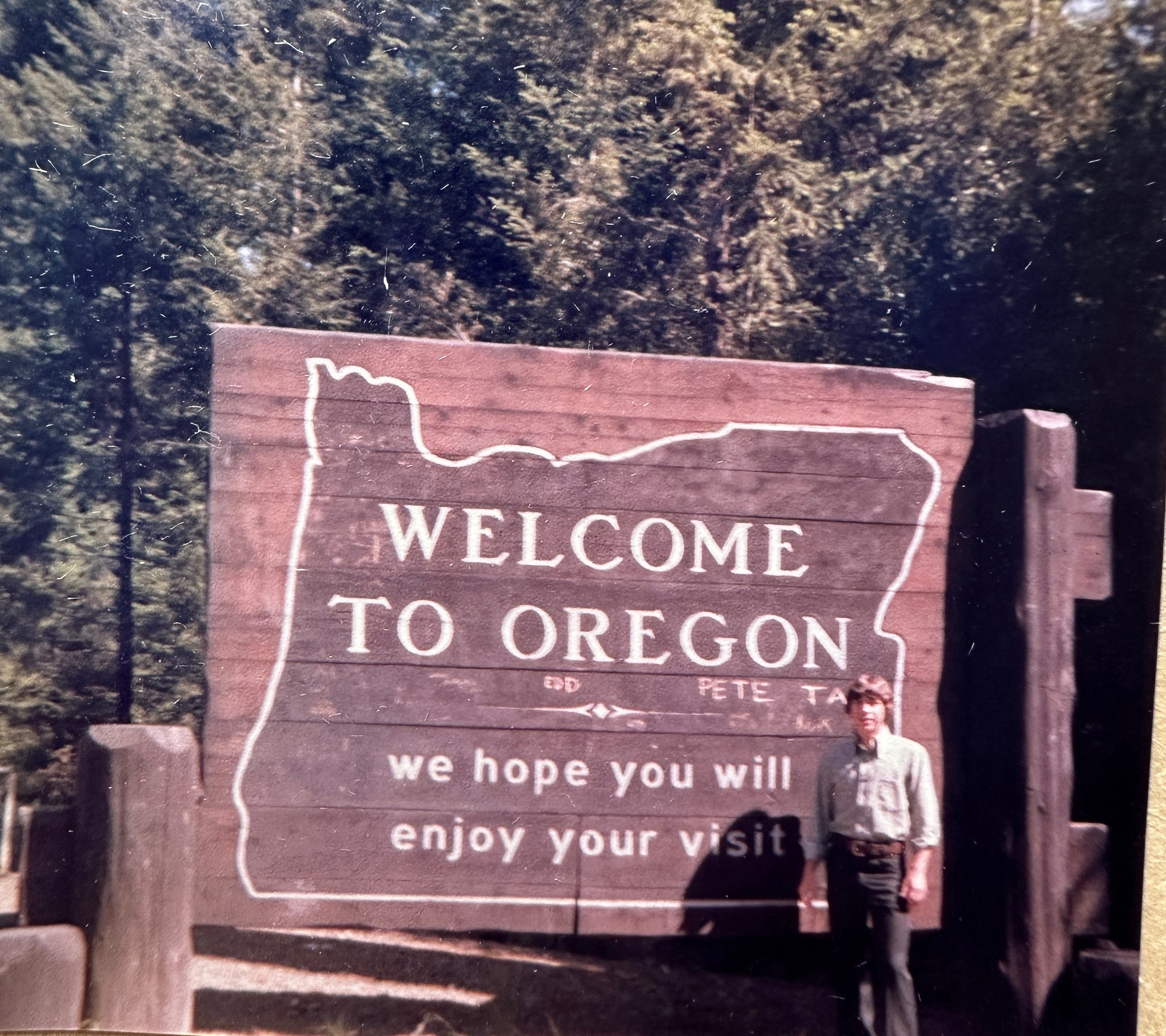
It seems that everyone wants to go to Oregon. Meriwether Lewis and William Clark led a team westward in 1804-1805 in an effort to find a way to reach the Pacific by boat. Nearly 400,000 emigrants followed the Oregon Trail from 1840 to 1870, traveling by covered wagon. And Dianne and I drove to Oregon in our little Toyota in 1978 to spend the summer there. Lewis and Clark took 18 months to reach their destination; travelers along the Oregon Trail usually needed 5-6 months; Dianne and I arrived after 2 weeks. Despite the different routes taken and the time required for the journey, we all traveled west believing that something worthwhile, perhaps even life-changing, lay beyond the next horizon.
The West is a key component of the American story, and the expansion of the country from east to west has been a dynamic throughout the history of our country. First the Vikings, then other Europeans, starting with Columbus, sailed westward. Of course, the “discovery” of America wasn’t an original discovery: the continent wasn’t “lost” and it was well populated with millions of Native Americans in all parts of the landscape when Columbus arrived. But to the western mind, it was a new find, and it initiated a tremendous focus and flow from east to west. After colonies were established in the “New World” by Spain, France, and England, the early colonists soon started to head to the West, motivated by gold, land, or God.
Dianne and I, in our recent Mountain West trip, learned a lot about this western flow, its motivations, its challenges, and its impacts on the American story. The story of the West is intense, varied but with some constants, heart-breaking and soul-crushing at times, and huge in its implications. It is so big that we’re dedicating three posts to some of the aspects that impressed themselves on us the most. We’ve already touched on a few of the highlights of the tale–the California gold rush, the transcontinental railroad, the Mormon march to Salt Lake City–but there is so much more to the story. So buckle up, let the journey begin!
Lewis and Clark left St. Charles, Missouri, in May 1804 with a group of about 40 hand-selected men to explore the newly acquired Louisiana Purchase, directed by President Thomas Jefferson to seek a water route to the Pacific Ocean, to record detailed information about the land they saw and any inhabitants they might meet, and to map the Missouri River and other areas as they traveled. They got a late start, waiting for their keelboat to be completed and for final supplies to arrive. They paddled against the current of the Missouri and found it stronger than anticipated. They also faced the formidable task of converting the group of men into a cohesive and disciplined team. The delays resulting from all of these caused Lewis and Clark to spend their first winter with the Mandan nation in what is now North Dakota, rather than making it over the mountains prior to winter snows as planned.
Setting out after a restorative rest and the winter thaw, they traversed the challenging Bitterroot Mountains and then realized that there was no easy water route to the Pacific on the other side, just range after range of more mountains. But they trudged on and persevered, crossing the Rockies in what is now Idaho. With dugout canoes, they then navigated the treacherous Clearwater, Snake, and Columbia Rivers, paddling this time with the current, for over 500 miles. The team finally reached the rugged coast of the Pacific Ocean on November 15, 1805, in the vicinity of modern-day Seaside, completing their westward journey. After exploring the coastline, they established winter quarters, building Fort Clatsop, just southwest of modern-day Astoria. They remained there until March 1806, when they began their 6-month journey home.
Dianne and I visited the Lewis and Clark Interpretative Center at Great Falls, Montana, and, even though we both knew the basic story of the Corps of Discovery, we discovered a wealth of information about their expedition. There was a description and model of the specially-designed keelboat, built to navigate shallow waters and occasional sandbars yet large enough to store all the supplies (the equivalent of almost 3 moving vans full!) and instrumentation they took on their journey. There was an exhibit about how they took readings using the sextant, a critical aspect of accurately mapping their travels. And there was a map and exhibition showing the 18-mile portage route required to get around the series of falls in this section of the Missouri. Despite the grueling 11-day portage and the seven round-trips required to bring all the dugouts and supplies forward, the team was in good spirits at the end of the ordeal; Clark recorded that “all appear perfectly to have made up their minds, to Succeed in the expedition or perish in the attempt.” Such was the commitment to the quest and the destination.
Lewis and Clark were explorers, venturing into a land of deep mystery to discover and document what was out there. Their overall mission was set by someone else, but the day-to-day details were completely left to them to figure out and adapt. They sought knowledge and to identify future commercial and trading opportunities for the country. They documented nearly everything, with drawings, measurements, maps, and sometimes samples. While Dianne and I aren’t exactly world explorers, the trip we made to Oregon in May 1978, with less than a year of marriage behind us, had some similarities.
I was in graduate school in urban planning at UVA (Dianne was an undergrad in Architectural History–both programs were in the School of Architecture) and required to do an internship between the two years of the program. Rather than pursue a position in Virginia like all my classmates, we decided to seek an adventure, to do something out of the ordinary. My professor and advisor made a connection for me with a City Commissioner in Portland, Oregon, and we jumped at the chance to travel cross-country (I had never been further west than Tennessee, so this was going to be a big adventure!).
Similar to Lewis and Clark, my mission/requirement for an internship was set by someone else, but how to fulfill that mission was completely up to me. I sought knowledge and experience for my professional career, thus our travel was all about future opportunities. We set off into the great unknown (to us!), ready for adventure and believing that the West held something special for us, too.
With very little money but lots of heart, we spent weeks planning and purchasing supplies, making numerous lists and identifying must-gets as well as nice-to-haves. We then departed for two weeks on the road from Charlottesville to Portland, seeing parts of Arkansas, Oklahoma, Texas, New Mexico, Arizona, and California. Like Lewis and Clark, we packed and repacked multiple times, trying to make the daily routine simpler and more efficient; we documented our travel day by day, including highlights and sometimes the mundane but nevertheless (to us) fascinating; and we managed our limited resources, sometimes camping in our almost miniature 2-man pup tent that barely protected us from wind and rain, sometimes venturing into a Motel 6 or Best Western, occasionally splurging on a real hotel. For a small town kid like me, seeing and experiencing the vastness of the country was a dream come true, and the challenges and inconveniences were just part of the journey.
We picnicked in front of a beautiful waterfall in Petit St. Jean State Park in Arkansas. We slept in sleeping bags on concrete picnic tables in New Mexico to avoid the rattlesnakes getting into our tent. We endured the boring scenery in parts of Oklahoma and the southwest, and we delighted in the artistry of Santa Fe. Our first view of the Grand Canyon was from the seat of a helicopter, and my first toe in the water of the Pacific was at the Santa Monica Pier. We indulged ourselves in San Francisco with brunch at the top of the Mark Hopkins Hotel, and we rode the cable car to China Town. We drove through the Redwood Forest and finally arrived in Oregon, travel weary but deeply satisfied that we had had such an adventure.
My work in Portland was quite interesting, and I learned some important things about local government function and finance, as well as how to work in a professional office. And we loved Portland, though someone in the office there dropped the ball about arranging housing for us and we ended up living in a short-term apartment with rented furniture in a nearby suburb. Portland was different from east coast cities, though, and we quickly discovered new foods (Dungeness crab!), restaurants (Spaghetti Factory!), parks (Washington Park and its International Rose Test Garden!), and activities. But, both at the time and now as we look back, the best part of the summer was the trip west and then the two weeks we took to return. Oregon for us was a call of opportunity and learning, yes, but primarily of adventure, and it certainly opened my eyes to the allure of the West.
This year of reflecting on our fifty years together has led to a number of conversations about things that have changed over that half-century, especially related to matters of travel. “Remember when….?” “How did we….?” And indeed, so much has changed: the internet has made trip planning so much easier (but also more challenging in some ways–too many options!), no one uses paper maps or Mobile travel guides any longer, and with Google Maps you can’t really get lost–just to name a few ways our travels today differ from our 1978 Oregon trip. But what if Lewis and Clark had been able to look ahead to the fifty years after their expedition? Imagine the enormous changes they would have seen: a steamboat could travel upstream without men paddling, railroads were moving supplies around so much more quickly than a horse-drawn wagon, most (but not all) Native Americans were in or en route to designated reservations, and hundreds of thousands of people had moved into the very territory they had explored. Manifest Destiny, a concept and belief held by only a relative few back in 1804, had become a reality, as the U.S. acquired Texas and the Southwest, California, and the Northwest Territory to go along with the Louisiana Purchase. Even on the eve of the tragic and deadly Civil War, the United States was a very different country from the days of Lewis and Clark.
Meriwether Lewis and William Clark and their Corps of Discovery in many ways opened up the West. They literally mapped the way and wrote the book. They started, or at least majorly advanced, the story of the West. So, so many followed their lead and became characters in that story, going west to find gold, to acquire land that was unavailable in the east, or to achieve wealth or freedom impossible elsewhere. We, too, went west in search of opportunity and adventure, a trip that set the pattern for a lifetime.

Lewis’s specially-designed keelboat 
The only member of the Corps lost 
An unavoidable, unforgettable adjustment 
Two of the five falls encountered, as they appear today 
Pulling and pushing dugouts and supplies for 18 miles! 
Our supply list–1978 
Returning from our first view of the Grand Canyon! 
Destination: Accomplished!
Leave a Reply